A post while on holiday…

A6F350BB-833A-4934-A73D-01BF9693ACA3
Right, I know what you all must be thinking.
“Effie, that is clearly not Paris in that photo.”
Correct. In fact, I am currently writing this post from inside the main reading room at the New York Public Library.
Why am I here? Well, a family member is getting married this coming weekend, and since the wedding coincided with the Toussaint holidays, I figured I’d come out early and spend a couple days in one of my other favorite cities.

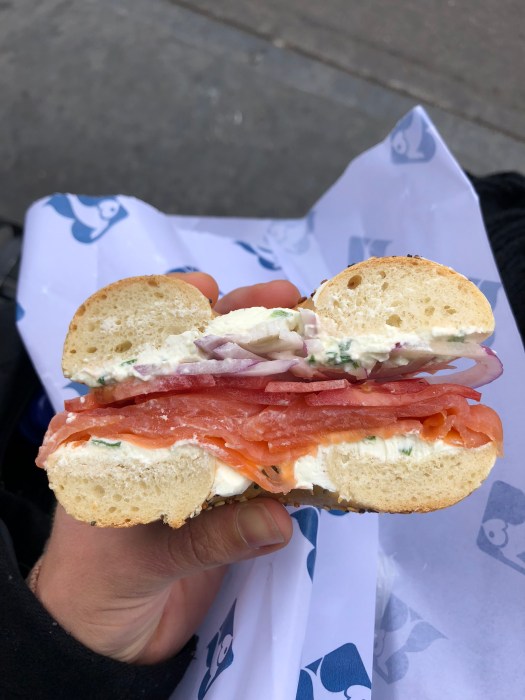
(And yes, it goes without saying that, other than seeing friends, a big motivation for spending a decent amount of time here was motivated by food. Especially pizza. And bagels. Seriously, Paris really needs to up their game when it comes to the latter. The pizza offerings are pretty good—especially if, like me, you really like Neapolitan-style pies—, but sometimes you just really want a bagel with cream cheese and lox and tomato and onion…)
80D27140-9D5F-470F-A3E6-2027DB6D8E21
Thankfully, Russ & Daughters was there to meet my bagel-craving needs. (Instagram @effie143)

As to the rest of my life, I’m not entirely sure why I let things (aka grading) pile up as much as they did, but between that and hacking through more chapter writing (albeit rather slowly…writing longhand first before typing everything up tends to do that), I haven’t really found a moment’s peace to commit to writing on the last five shows I saw since my previous post.
Given that, the write-ups are going to be a bit more brief than usual, as there is quite a bit of ground to cover and not a whole lot of time to cover it in. Besides, I’m not entirely sure that a multi-page treatise on each of the shows would be particularly attention-grabbing.

Anyway, let’s start with the first : Richard Maxwell’s Paradiso at Nanterre
First things first, despite the name, this play has nothing to do with Dante’s Divine Comedy (even though, as with Dante, this is the third part of a trilogy of works). What is presented here, rather, is an exploration of the post-human, that is, what remains in terms of form of expression after an eventual apocalypse. For this production, the playing area (I’m not entirely sure one could call it a ‘stage’ for reasons I’ll explain in a bit) of the salle transformable was covered with a white flooring, on the edge of which were arranged three rows of simple wooden benches. There were no raked seats, no ‘gap’ between the playing space and the first row of seats. We were all blended, or gathered, into the same delimited area.

Other than the benches, the space was relatively bare, save for a screen onto which subtitles were projected (the performance was in English). Oh, and a pickup truck. Yes, at the start of the show, the large factory doors were opened, and a silver pickup drove in to music that could best be described as at once ethereal and futuristic. The truck took a few turns about the open space before the driver engaged in the always frustrating endeavor of parallel parking upstage left.
And yes, before any of you ask, he did do that thing where you just keep backing in and out and slightly readjust the wheel so you turn like a quarter-inch, but even that isn’t enough so you pull out and readjust again by about a hair and…god it almost makes one want to yell enough already (if said person wasn’t also giggling at the sheer banality of this gesture).

Anyway, once the car finally stops, one of the back doors opens and out comes—or more precisely “rolls”—not one of the actors but a little robot. A little robot on a rudimentary four-wheeled apparatus, whose “eye” was what looked to be a web camera (but one from about five or six years ago). This is our first introduction to the piece: a machine who speaks in a cadence familiar to those who have ever played around with the read-aloud function on a word processor. Artificial, cold, precise, devoid of subtext even when the words actually being said could—assuming the “human” was not removed—have been spoken in such a way so as to convey some “deeper meaning about life”.

I put this last bit in quotes because one of the things the piece concerns itself with is precisely this question of “profound meaning”, especially once the human characters—four of them, an older woman, an older man, and two girls around my age—come in and start speaking in platitudes themselves, but in such a way that evoked the kind of stereotypical community theatre performance style parodied in Waiting for Guffman than anything that was supposed to convey something beyond “these are phrases that sound important but in the grand scheme of things really don’t mean much.” It is the human transitioning into its own obscurity through speech. Hell, the ending—if one could call it that—involved the “family” getting back into the car and driving back out into the street, leaving the little lonely robot in their wake. Said robot then began printing a very long receipt of text, though not the text of the script itself.
There was no curtain call, no bows, no moment of congratulations for the cast. Eventually, as the robot kept printing, some audience members tentatively got up to inspect the writing, constituting an “end” if there ever was one.
I mean, if the concept of storytelling is a human construct, do its conventions still hold once humans disappear?

While you all ponder that…let’s move on to Mama by Egyptian playwright Ahmed El Attar, performed on the main stage of the MC93.

Ooooh boy where to start with this one…
On the one hand, the exploration of the dynamic between mother and son in Arab/Mediterranean/Levantine (or even former Ottoman) cultures is one that resonates rather well with me (Greek and Middle Eastern/Arab cultures have quite a few similarities as far as this is concerned), and deserves to be told.
On the other hand, is it really necessary to, again, place the onus of change onto the backs of women? One of the things El Attar discusses in the show program is the manner in which he feels women in his country are still subject to certain levels of oppression brought on in large part by the distinctly patriarchal/machismo culture in which the society in which they live is structured. Women counteract this, he states, by forming close, influential bonds with their sons, especially the eldest, as it is through the eventual installation of the son as the head of the family that the mother can hope to gain some level of power or control. The problem, however, is that this keeps perpetuating cycles of oppression, as though the mother has an illusion of power through the level of control she exercises over her son, she still does not have access or opportunity to gain equal footing with him, or other men, in general.
What I have an issue with, however, is not necessarily the fact that El Attar pinpoints a certain kind of internalized misogyny that manifests itself in this, but rather his insistence that the responsibility for change is found solely in the mother, as men, he states, will never change and we cannot hope for them too.
Look, whether or not a mother realizes that what she does could perpetuate cycles of sexism/patriarchy/oppression does not change the fact that her efforts will amount to very little if there is not a general overhaul of the sociocultural structure in which she lives by those who actually have power, aka men.
Also, I mean if we want to talk about giving women more of a voice and influence, perhaps we could start with the fact that this play presented a story centered on Egyptian women, but that was written not by a woman but by a man. Give women a seat at the table, let them speak of their experiences themselves, of how they see their place in the world, and then we can talk.

Anyway…

I was not really a fan of this production, but I don’t attribute this entirely to the fact that reading the program notes before the show started left a bad taste in my mouth. For one thing, the show was in Arabic, but the screen on which the subtitles were projected was placed so high up—the stage is rather tall at the MC93—, that unfortunately reading the subtitles to understand context sometimes meant missing some of the subtle body language cues on stage (and thus subtle evolutions in different characters’ relationships to one another). Second, apparently El Attari is a fan of a collage-style of playwriting (this is the first of his plays I’ve had the chance to see, so I can’t speak to how it did/did not work in other cases), which did not quite work for me. I have a feeling this may have something to do with the fact that the sound cues—our signal as to when a transition was happening—were incredibly off, but the pacing seemed very inconsistent from one vignette to the next, resulting in a piece that was more incoherent than I think it had the intention of being. If we are meant to view in the course of this production a shift in family dynamics as one generation yields to the next, there was a distinct lack of urgency in which every action was carried out that it almost made one want to ask what the point of all this was.

Oh, and then at one point a woman came out and sang an Arabic rendition of R Kelly’s “I Believe I Can Fly”. Yeah.
Right…show number 3: Maeterlinck’s La Princesse Maleine, this time in the smaller theatre of the MC93.

I’m going to be really brief on this one: melodrama is not my thing. Neither, apparently, is symbolism. I don’t care that there was ice all over the stage, meaning that every time someone had to move at anything faster than a careful walk it became an exciting game of “Try not to slip and break yourself”. I don’t care that there was some rather interesting projection work being done. Having to listen to someone slowly moan out variations of “Oooooooooh nnoooooo” or “Ooooooooh deeeeaaaaarrrr” is not my idea of a fun two hours.
Yeah…we’re just going to chalk this one up to “sometimes we really just don’t end up liking things, and maybe this will just be a play that we will forget about when it comes time to writing the chapter on the MC93 for the eventual dissertation…”
Onto number 4: Affordable Solution for Better Living, at Nanterre (in the design workshop)
Less a theatre piece than a dance/performance art piece with text, this production centered around a single performer (dressed in not one but two of those sheer looking body suits) who spends the first half of the hourlong production building an IKEA bookshelf.
I mean, you really cannot get more banal, sterile or supremely ordinary than a white IKEA bookshelf, or more precisely than the assembly of a white IKEA bookshelf. The thing is designed to be so impersonal so as to fit within nearly any lifestyle. It is a thing without much substance. A pure object. And this man—or rather humanoid creature, as the first of the two body suits has the actor’s face printed on the bit that zips over the head, bringing the whole thing crashing smack-dab into the uncanny valley—places it together with an intricate precision of gesture, any deviation from which results in an error message from a disembodied, robotic, female voice that also at times offers reassuring messages such as “You are a responsible citizen.” “You are doing well.” “Only those who sleep don’t make mistakes.”
After the bookshelf is complete, stagehands unload a few other pieces of white/beige IKEA furniture, and the stage space is thus transformed into the approximation of a “living room” (I’d say the Platonic ideal of a living room, but I don’t quite feel much like discussing Plato’s cave allegory at the moment). The “human” then slowly sheds his first “skin” revealing a second body suit with muscle fibers printed on it underneath. His body as a whole remains recognizable as that of a “Human”, but only a close approximation of one. As he interacts with/climbs on and over his furnishings, he only moves closer to becoming a non-human figure than a fully realized person.
He does, however, have a voice, though it, like the female voice earlier in the piece, is disembodied, emanating from a mic hanging over the stage. His body reacts to his words, but the absence of a moving mouth to bridge the final connection between the voice and its source renders his particular “human-ness” divided.
And finally show number 5: Winter Family’s H-2 Hebron, again at Nanterre, and, as with the previous show, in the design workshop

Here is a quick sum-up of this show: a documentary theatre piece in which one woman speaks the words of four different individuals. It’s polyphony and contradiction, battles for control of a narrative, in the site of a singular body.

Given that the show centers around the conflict surrounding the increased Israeli colonization of the city of Hebron (which both Israelis and Palestinians claim ancestral ties to), the choice to structure the show this way actually makes quite a bit of sense. To be honest, it took me a minute to realize what was going on, as hearing contradictory statements coming out of the actress’s mouth without visible change in inflection to signal a change of character almost made me think my comprehension skills had become inexplicably rusty. Thankfully, I caught on as to what she was doing after a bit.
The space was set in a bi-frontal structure, with the middle being occupied by a long table, covered in a black cloth. This, we would discover, was where the city of Hebron would be built in miniature over the course of our “tour” there. Indeed, one of the inspirations for the writing of this play came from the artists’ experiences encountering various tour groups (oh yeah, war/conflict tourism is a thing) while on a visit to the city, as well as noting the differences not only in information but rather in the way certain information or history was framed. We then, as an audience, were transformed into tourists, though given that we were presented with multiple, often incredibly contradictory narratives, at once, the responsibility in the end was put on us to determine what “truth”, if any, there was to be gained about the situation. There is, in this, an assumption that we who are seated there before our singular yet multiplicitous/fractured “guide” are smart enough to think critically enough in order to unravel the complexities of the situation, which to a certain degree, I find to be a bit more effective than some of the more straightforward didactic theatrical presentations I have seen over the past year. Given the situation at the center of the play, however, I question the limits as to how far such an approach can go. There is a question of active colonialism at hand, after all.

Right, with that, we come to a close on another round of “Effie hurriedly writes things down before she procrastinates even more and the task becomes almost insurmountable”. If you need me, I’ll be downing another coffee…and staring at a small pile of papers that need grading. Work never ceases, even on holiday.


7741FA6A-61EF-4EB9-934E-130AB09134AF
Where I’m writing from…

197 – 212


2941DE2E-7388-4199-AE06-B29E8E23906B
Spring!


The usual two+ week not writing gap continues, only this time I can definitely say it has more than a little to do with the fact that I’ve spent the last two weeks doing a whole lot of nothing (other than reading + workshop rehearsals + occasionally going outside…last week was insanely gorgeous). We’re coming up to the end of spring break here though, meaning that come Monday it’s back to teaching, only this time with heightened levels of senioritis to tackle from my Terminales (can’t say that I blame them though).

I will say though, being outside as much as I have, not just with all the walking I’m doing again, but simple things like reading my books in the park instead of at the library, has been positively magnificent for all the recharging I wanted to do.


610BB307-FCEA-4212-8DE8-9214AF2F6E46
A café en terrasse at La Fontaine also helps…

For the most part, though, I think the word I’d use to really describe what the past couple weeks have been like is patience. To be more precise: relearning patience. I had spent the better part of a good number of days constantly refreshing my email, waiting for responses/feedback on the new version of my prospectus (yeah, I know, I’m a bit behind…technically…in getting this approved, but that’s what happens when your project gets a much-needed giant overhaul). Thankfully some incredibly constructive feedback came (and honestly, given how I wrote the thing when I was feeling pretty blocked and just sort of hammered things out, I’m surprised that there wasn’t more noticed paid as to how very obviously rushed it was haha), but there was a point where I just had to mentally take a step back and remind myself that I could (I should) just keep pushing on as though getting feedback was a non-issue. We can call this an attempt to regain control over how my life goes.


Thinking back, I’ve also realized I haven’t really been writing too much about my dissertation specifically, which is funny, considering that it’s such a big part of my life right now. Maybe it has something to do with the fact that, other than going to see shows (more on a recent one I saw in a minute), the majority of the work takes place sitting in the reading room at the BNF. Not exactly the most exciting of times.


Really though, it also has to somewhat do with the fact that I’ve always felt a bit nervous about publicly sharing my intellectual/academic work. Call it another manifestation of imposter syndrome, but I’ve always been someone who likes to get this kind of work out little by little to people I trust to give me feedback instead of just shoving it out there like a baby bird out of a nest. This is also a bit funny to think about because when it comes to performing, I literally have no issues putting myself out there, or being vulnerable in front of an audience. Might have something to do with the sense of power that I have doing that. Or if not, then with the fact that oftentimes I still don’t trust words completely to get across what I’m thinking/feeling. I find abstract (or not so abstract) gesture to be more conducive to that, as far as my own means of expression are concerned.


16F9C0A5-F2E7-4C2D-91E5-C854C3A71424
This has nothing to do with the above…just some chickens I met on the way to rehearsal a couple weeks ago


Anyway, on to the show I saw.

557E2EFF-01BD-4F77-B574-09F170E132C4


Jusque dans vos bras is a satire on the notion of identity, and French identity in particular. Taking a humorous look back at the history of France and some of its major players, the play puts front and center a question that pretty much characterized the tone of the last presidential elections : what does it mean to be French?


As someone who is definitely not French, I will say it was interesting being in the audience as a sort of outsider, especially given the fact that a good portion of the beginning of the show involved a direct address wherein the audience was (unless I’m misremembering) addressed not only as being of French origin, but also of a certain socioeconomic demographic that is characterized by the fact that they all (myself included here) took the metro from Paris to get to the theatre that evening (the MC93 in Bobigny). Generally though, a good satire should be able to transcend these sociocultural/-ethnic bounds – and I will commend the piece for starting off almost immediately with a sketch that put front and center questions of Frenchness with regards to ethnicity, race, religious affiliation, etc. -, but I’m not entirely sure this one quite got there, given how specific some of its jokes and references were to a certain cultural understanding. Honestly though, I did feel pretty proud of myself for being able to pick up some of the more subtle digs at the current president.


A high point: during one of the sketches (there wasn’t really a through-line in this piece), the actors are wheeled out on a raft, which is then parked up center stage. A rope is thrown out. The actors are tired, weary. One of them stands and stretches out their hand asking for help being pulled to shore (downstage). This, of course, is an explicit reference to the current refugee crisis, but at the same time it also interrogated the relationship and ‘gap’ between the fiction being played out on stage and the audience. After the initial request was made, no one moved. The actor pleaded again for help, and then when no one in the audience still climbed up on stage to grab the rope, said actor, plus a few others, started making cheeky remarks about how heartless everyone was, and really they were sure that being in Bobigny (which is a historically left-leaning area) would mean that people would be scrambling to do something. It was at this point that the audience understood that yes, they were meant to take that step and cross the gap between themselves and the stage, inserting themselves into the fiction being played out before them. And yeah, this is going to be a bit silly, but almost immediately after people scrambled up to help – it never ceases to amaze me how eager people get to participate only the minute they are assured that it’s ok and no, they won’t be breaking any rules -, two other actors wearing silly shark costumes came up to attack. I died.


Oh and at one point there was also an inflatable dancing bull.


Low point: the blackface.


Oh yes. That happened.


« But, Effie, » you might be asking, « they painted their faces/hands red, not black, and besides isn’t there a completely different cultural context here that you have to take into account? »


No, there isn’t. I don’t care if the whole point of the sketch was for skewering white families for taking in immigrants from sub-Saharan Africa (a good chunk of which was, let us remember, colonized by France), and then making backhanded comments to try and demonstrate a level of cultural superiority, thereby in a sense reconstructing the colonizer/colonized dynamic. There are ways to do that without painting white actors’ faces. End of story.


I’m going to end this post with just a short note that on the evening of April 26, I officially added a new restaurant to my list of ones I readily recommend to people who come visit. Unlike the other restaurants on my list, however, this one happens to also be vegan. Given that I always like to be aware of friends’ diet concerns/preferences, I’m more than happy to say that Le Potager de Charlotte is a restaurant that anyone can enjoy!

Processed with VSCO with nc preset
The only time I will eat a deviled egg…when it’s an avocado and there are no eggs involved.

Processed with VSCO with al5 presetProcessed with VSCO with a8 preset


I’m off to London now to meet a friend for a last weekend of adventure (and rain), which also includes seeing a show I’ve been waiting to see for years. Three guesses as to which one…


113 – 118

Hectic week (and a bit of a stray cough from losing my voice from talking so much) means I’m a bit behind. Anyway, here’s a rundown of the past week, in no particular order with regards to dates.


452A0F26-1EFE-4D8B-B4BC-C5DA85943628
Thought this was amusing


First off: I just want to bring everyone’s attention to the fact that Raviolis Chinois Nord-Est offers 10 dumplings for just 5euros. Aside from adding this to the ever-growing list of reasons as to why I love the neighborhood I live near (and will hopefully continue to live in next year), this is probably a good time to once again reiterate some difficulties I have whenever I get asked for restaurant recommendations by people visiting. It doesn’t really need to be specified that the kinds of restaurants usually sought-after are French ones (you know, kind of a priority when visiting France), but the thing is, when I go out to eat, I don’t usually go for French food. One: I can pretty much acquire all the cheese, charcuterie, breads and pastries I desire from my local market (and also, when it comes to classics like soups and stews, I can make those at home). Two: it’s not exactly the most affordable of dining options, with one or two exceptions. You know what is both affordable and delicious? 10 dumplings for 5 euros, that’s what (I highly recommend the pork, cabbage and mushroom ones).


To continue on the dumpling theme, this evening included a midnight snack of sorts with a friend of mine at Le Pacifique, another establishment not terribly far from my place, and which has the added bonus of offering continued service from 11h00 to 01h30…yeah as in AM. Prior to stopping there, we paid a visit to a couple bars in the area (namely Combat and Le Renard) for Paris cocktail week.


Processed with VSCO with s3 preset
Cocktail special at Le Renard


Anyway, back to Le Pacifique. I’m not sure how, but during the course of the evening, the conversation turned to dim sum (more specifically, whether or not any places that served dim sum cart-style existed in this city), which later developed into a craving for some late-night dumpling snacking. As it was around 23h30, Le Pacifique was really our only option, but as it had caught our eyes on the way to Le Renard from Combat anyway, the lack of other options wasn’t really that disappointing. We ordered two kinds of dumplings : pork sui mai, and one only labeled as ‘fried with five-spice’, along with a small Tsing Tao to share.


I’m not entirely sure if it was because of the late night, or the two cocktails from earlier in the evening, but those fried dumplings – or, to be more accurate, little football-shaped puffy, gluant, pillows of joy – were just about some of the most heavenly things I put in my mouth that evening. The fact that they were fried and filled with what we assumed to be pork – the menu didn’t specify – probably had something to do with it, but believe me when I say we sat rhapsodizing about them for a good half an hour after we were finished. For the sake of preserving the memory, I’m going to wait a bit before heading back there, but given their pretty decent dim sum offerings (cart or not), I have a feeling I’ll be back soon to make my way through the menu anyway.


Right, moving on.


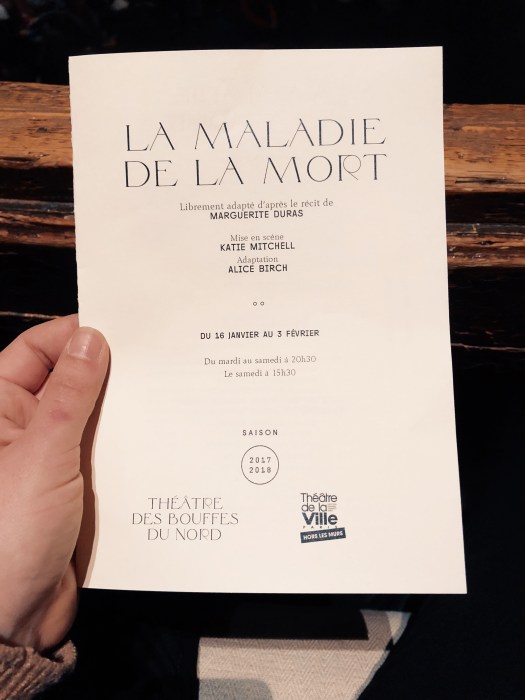
This week I also happened to see two shows involving video projections. First, La Maladie de la Mort (an adaptation of the Marguerite Duras text of the same name) at the Théâtre des Bouffes du Nord (for all you theatre geeks, yes this is the theatre Peter Brooke used to work in).

Processed with VSCO with u3 preset
Instagram @effie143


I want to preface this commentary by saying that although I’ve hinted at my let’s call it ‘suspicion’ at the almost default status of the frontal relationship in theatre/staging, I do think it is still possible to use the format in a critically successful way. Case in point: the stage here was set up not unlike a film set (complete with an ever-present camera and sound crew), meaning that there were points where a good part of the stage – or from my perspective sitting on the extreme right side of the mezzanine, most of the stage – was obstructed from the audience’s view. In light of this, a screen was set up above the stage onto which was projected both what was in the process of being filmed as well as some pre-recorded segments.


Given that the narrative – for those unfamiliar with Duras’s novella – revolves around a man paying a woman to come visit him nightly in a hotel room to teach him how to love, the use of the screen and video, in juxtaposition with the real-time staging and recording of the action, was, to me a logical way to explore the way in which we consume images/media, and that involving women’s bodies in particular. The connection to the pornography industry is, of course, evident, and put even more in the forefront by the fact that, periodically, the Man would open a laptop to watch a pornographic scene with relative indifference. Interestingly though, even though there were moments where I wished I could simultaneously watch what was happening on stage as well as on screen (especially during moments where one character was being filmed and the other was prepping for their next scene, or when a pre-recorded moment was playing while the actors themselves were readying for their next cue), thinking back, I feel that one of the results of this permanent denial of the gaze is how it enhances the flatness or lack of depth that comes with sitting in front of a screen to consume images/media. The background work, the bodies, the in-between cuts are missing all for the sake of constructing a singular narrative. Maintain the image over the body that brings it forth.


Coincidentally, the piece I saw last night was also an adaptation – this time of Strindberg’s  Ghost Sonnata – that used simultaneous recording/projection as a central part of its staging.


Processed with VSCO with a5 preset
Instagram @effie143


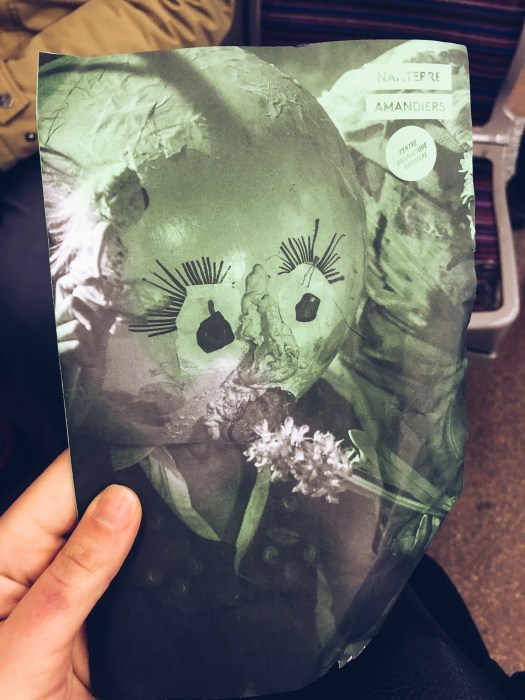
I was back at the Theatre des Amandiers in Nanterre for this one, only this time instead of the usual audience/stage set-up in the main theatre, a tri-frontal stage was set up on the stage itself. As we all filed in to take our seats around the playing space – on which were set up a couple of what looked like cardboard house-type structures as well as a crude paper mâché fountain in a baby pool – a large quadri-frontal video screen projected images of other audience members as they walked in, not unlike a video surveillance system in a shop. Coincidentally, this is also how I discovered my thesis advisor was in attendance. Amazing what this quasi-Big Brother-like gaze can do.


The play opened with director Markus Öhrn walking on stage, looking not unlike a more zombie-like Marilyn Manson, to welcome everyone, as well as to set the general vibe for the evening by inviting audience members to switch seats as they wished or, should nature call within the next 90 minutes, get up to use the restroom and then come back.


I always find it interesting how, especially in theatre settings, whenever audiences are told they have the option of movement, they rarely, if ever, take advantage of it.


In this case though, this may have had to do with the fact that we were more reliant on the projected images than I think I would have liked to take advantage of the fact that there were a few empty seats around that we could move to. Granted, I don’t think keeping much of what was happening enclosed in the cardboard structures helped matters, nor did the lack of places to sit anywhere except in one of the four banks of seats around the stage. If the goal is to break with spatial codes or the architectural imposition of theatrical spaces, a spatial design that not only, to an extent, reinforces a certain set of frontiers and boundaries between space reserved for playing and that for observing, but also functions on a system of surveillance both with the early video projection as well as the fact that it was very easy to train one’s gaze on the other audience members sitting on the other side of the room, does not necessarily invite divergence. If anything, this show that at first seems to want to move away from frontality actually ends up reverting back to it.


I also think I made the somewhat poor choice of sitting in a front row of seats, as I had to crane my neck up to watch the videos (the play was in Polish with surtitles in French and English, so reading along was almost necessary on a linguistic level as well). Towards the end of the show, however, I found that I was paying less attention to the videos, and more to the little moments that these Jack in the Box mascot-meets-a-flamethrower grotesque clown figures moved about the stage, peeking out of the cardboard box windows, playing a bit with our gaze on them. Perhaps if there were a bit more of that – actually, I think the production could have done away with the text almost entirely, aside from the little intro video played in the beginning to explain who each of the characters were – the frontal relationship could have been broken down further. Then again, one of the first major sequences involved a rather violent rager in a concert hall (which followed honestly one of the funniest sequences in which a character tries to find his seat at an opera house, all in the very frustrating but incredibly real style of a dream sequence in which you know the thing you seek is right in front of you, yet your mental state refuses to let you accept this), which was maybe a bit too reminiscent of the In Yer Face theatre of the 1990s in the sense of, “can this thing which has been done to the point of transforming into an almost codified aesthetic still be impactful”.


Anyway, enough of that. Here’s to hoping for more frequent postings next week.


479DE269-30C8-49AB-A7EF-E79477DBD4C5

107

Amazing the things that can happen when you finally get out of your own head.

These past few weeks – as some of my posts can attest – I’ve been grappling with some pretty unruly writer’s block with regards to my dissertation prospectus. Although I had jotted a few notes down here and there, I had yet to attempt to flesh out anything, partly due to my recent project change, partly due to a feeling of uncertainty that I had any authority to say anything about my subject (though this could also be linked back to the first point). It was getting to the point where I could almost feel myself bending and overburdened by stress – the jet lag was certainly not helping either – but then last night, in what I’m calling a brief flash of sanity, I reserved myself a spot at the BNF, the goal being to go there with just my ipad, park myself in a chair, and write.

And although towards the end of the afternoon, coherent paragraphs gave way to rather extensive bullet points, I can say that I left this afternoon feeling very productive and clear-headed. In short, I have a lot of thoughts, but at least for now they’re out of my head and filling up a word doc instead. There are still gaps to fill, I am fully aware of that. My goal was never to write a ‘perfect’ document. But I can start to see the gaps more clearly, at the very least. It’s almost as if I’m untangling myself from the weeds.

Progress is a slow, steady thing. Sometimes I still need to remind myself that I’m not tasked with writing the next great text that absolutely must upend everything and completely revolutionize the field, etc. etc. etc. Not that this should downplay what I’m working on, just that maybe I need to slightly readjust my way of thinking. Let the project just be. Nurture it, change and grow with it instead of trying to force it to become some idealized…thing (also, idealized according to whose standards?). Anyway, I told myself that this year I would actively try to be less hard on myself when it came to my work. Perhaps now would be a good time to start.

96 – 97


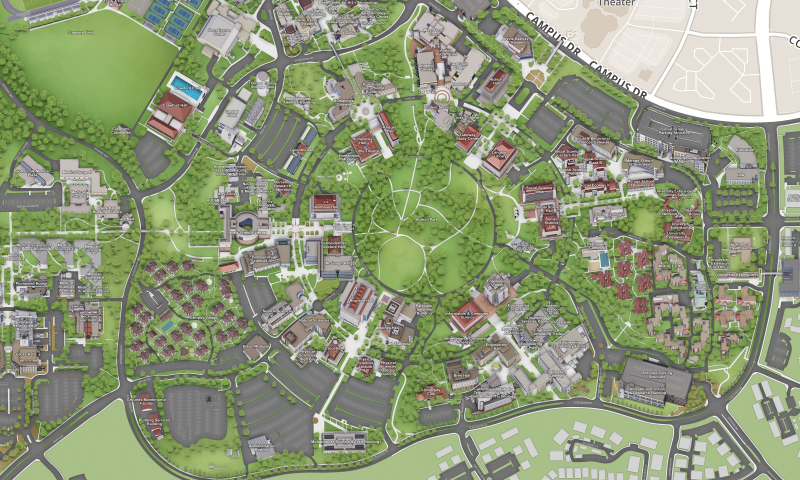
This is a map of UC Irvine.


For those unfamiliar with the campus, let me briefly break this down for you. Built in the mid-1960s (right around the time when student demonstrations on other UC campuses – notably Berkeley – were at their peak) UC Irvine is located in what was once a lot of open land. As such, the good people of the Irvine company had the freedom to construct not just the university but also its immediate surroundings in a way that, to a certain extent, responded to a growing need for a restoration of order on otherwise fraught college campuses.


Organized in a ring, the different departments and schools of UCI are notable for their detachment from each other. Indeed, rather than evoking an image of unity, the ‘rings’ of Irvine’s campus give more the impression of a panopticon than anything else. Although there is no looming tower in the center of this circle – as one would find in Foucault’s description of the panopticon in Discipline and Punish – the park at the center of campus presents its own set of conundrums. Although it is quite sizeable and provides plenty of space for picnicking and other outdoor activities, it is also very hilly. The walking paths shown in the picture kind of suggest this, but what this essentially leads to is a park with no ‘center’, that is, no point of convergence. I remember when I took my first tour of the campus before becoming a student back in 2008, our guide evoked the image of the campus layout resembling a bike wheel (a reference more to the fact that the school really, really wanted people to bike more, rather than to its having an actual cycling culture). Thing is, though, even the spokes on a bike wheel – what keeps its structural integrity intact – have a central point where they all cross.


The problem of the lack of centrality on this campus became very clear during the recession and the resulting exhorbitant rise in tuition fees. As with the other UCs, there was a mobilization effort on campus, but unfortunately, our efforts never took off to the extent of those in Berkeley or, memorably, UC Davis. This could be attributed to several factors, but here are a few I stand by:

1. The isolation of the different departments in distinct buildings, although common on many American campuses, created here a sense of ‘each department as its own island’, further emphasized by the fact that, given the circular structure of the campus, there was always a sentiment of someone watching.

2. Returning back to the park, the lack of centrality meant that there really was no natural ‘meeting point’ for students (and some faculty) to gather during demonstrations. Demonstrating on the steps of the admin building worked fine for a bit, but its location as a sort of offshoot of the greater ‘Ring Road’ made it a somewhat inconvenient place to get to for students in classes on the other side of campus.

3. What the Irvine company decided to build in the immediate surrounding area. Although we had a small shopping center just across one of the bridges leading to campus, the immediate area around UC Irvine was taken up by residential developments. Condos. Apartment complexes. Not occupied solely by students, but by private families as well. There were no student bars (the exception being the on-campus pub, but even they had to defer somewhat to campus rules regarding opening/closing times), coffee houses were pretty much various locations of impersonal Starbucks and Peet’s coffee, and in order to get anywhere of interest, one had to drive. In short, this was the anti-college-campus campus.


I bring this up because I could not help but think back to this last night after the show I saw (the title is actually a quote from architect Emile Aillaud and is rather long, so I’ll just let the photo speak for itself):

9CF61198-9DD8-4336-A831-361D1E086D0A.jpeg


Much like the last show I saw at Le 104, this show centered around a group of three ‘researchers’, this time interested in the architecture of the grands-ensembles – also known as the ‘cities’ of the Paris suburbs (banlieu) built starting in the early/mid-1960s as a response to a need for more housing (because, surprise, when your government starts calling for people to make more and more babies, eventually, these babies and their families will need homes). Originally populated by working class families, including a large number from Southern Europe (Italians especially made up large portions of the construction crews) and designed to be close to whatever factory the men of these families worked in, the reputation of the grands-ensembles did not take long to deteriorate. Instead of being heralds of the future, the cities were cold, impersonal, lacking life, isolated from the hustle and bustle of the city. As the years passed, the conversation around the banlieues shifted to them being sites of urban tension, of violence, of upheaval (and yes, there is a racial element associated with this, in case you were wondering).


Anyway, back to the show. The first thing that was remarkable about this performance was that, for once, it was not frontal. Instead, it was a theatre in the round (well, 3/4 around) with the playing space in the center containing a set of white cubes (seen in the picture above). During the opening of the show, the cubes were organized in a way that four of them made a center ‘block’ and the rest were posted in sort of ‘tower’ formations in the four corners of the space. In other words, the space was centered, organized, we could easily create a relationship with it.


Then the actors start recreating, rebuilding, reconstructing, deconstructing, the various evolutions of one of Aillaud’s designs for the grands-ensembles. Suddenly, the center exploded. No longer stable, the blocks were set in serpentine positions, creating a sort of labyrinth on the stage that, to those of us in the audience, changed the way we related to the space in front of us. No longer part of a shared ‘laboratory’/research space as in the beginning, we were now almost god-like, looking down on this aesthetic achievement below us. Meanwhile, the actors themselves weaved around not only the blocks in the center of the room, but the spaces, the gaps between the banks of seats, the sound design at times making it difficult to pinpoint exactly where one of them was at any moment. And as they, with their literal and figurative acts of destruction and construction, traversed through time to try to puzzle over how or what to make of these constructions today, the absence of the voices, the bodies, of those living in the grands-ensembles became more and more evident. For once, I think the deliberate exclusion of certain bodies (not just voices, but physical, present bodies) worked very effectively here. Indeed, at the end of the play, we see the actors in the process of creating their own ‘micro city’, designating certain blocks as community centers, pharmacies, cultural centers, parks, etc., when one of them, in the closing lines, asks:


“And what about the residents?”


That, I think got to the crux of the matter. These cities were designed with aesthetics, rather than livability in mind. Is this not what happens, though, when urban spaces are designed entirely artificially instead of allowed to grow somewhat organically, when space overly tries to dictate what its inhabitants do and how? This search for an architectural utopia lead to the sacrifice of the human, the mortal, lived element. Despite what is implied in their name, these grands-ensembles were not designed for community, neighborly living (then again, when one thinks about when they were built and who they were originally built for – to say nothing of who is “relegated” to live there now – it is not hard to see why a more divided, sequestered population would be ideal).


This, really, is what brought me back to my days at Irvine, and I’m pretty sure I talked the ear off the friend I went to see the show with about that! Otherwise, I don’t know if I can say enough how positively refreshing it was to see a troupe propose a different interpretation of the playing space, not just in terms of simply not being frontal, but something that finds the gaps in the structure, that makes the space almost alien, strange, uncanny.


Tonight I saw another show, Tue, hais quelqu’un. It was fine. There was a point where they overlaid images of the actors over their bodies, which created a really cool painterly effect, further amplified when the actors began ‘manipulating’ their images through gesture.


Clearly, however, my mind is occupied by other things.


88 – 90

Processed with VSCO with b1 preset
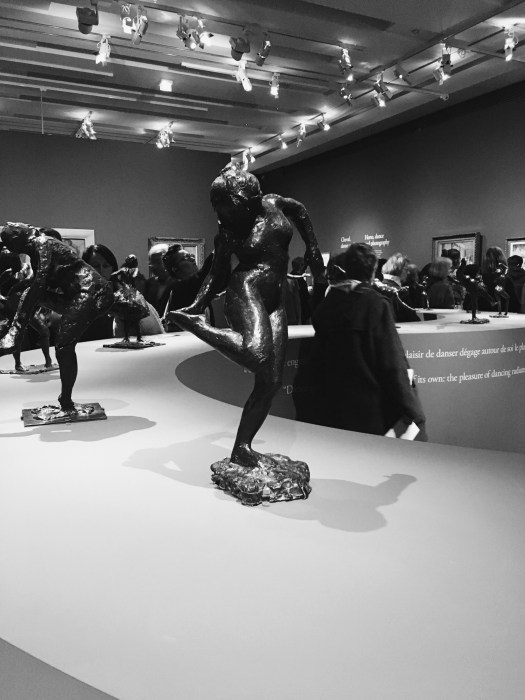
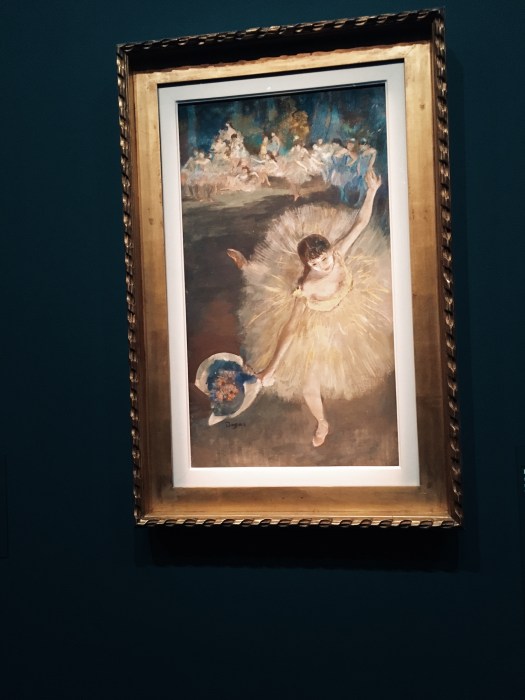
Degas – a series of dancers


Networking.


I’m not the biggest fan of it, yet it is one of those necessities of my field. I think it partially comes from the fact that, seeing as I was kind of an…eccentric, weird kid growing up, my social skills edged very close to the “oh yeah, no, this person definitely has no interest in speaking to me about my interests” territory. Thankfully that’s abated somewhat – who knew that all it took was surrounding myself with other people who liked the same things I did – but that little tinge of anxiety always comes up in one particular situation: sending emails.


And yet, here I am sending out emails to people I hope to speak to about my project, patiently waiting for a response all while wondering whether ot not the lack of one means I came off like some kind of idiot in my message. There’s a term for this…oh yes: imposter syndrome.


Yes, once again that…thing…rears its ugly head.


Thankfully, though, there are ways to distract from it, at least momentarily. One of these ways is stopping into the Musée d’Orsay for a bit to check out the exhibit Degas Danse Dessein. Hommage à Degas avec Paul Valéry, which examines some of Degas’ works through the lense of writer/poet Paul Valéry – who coincidentally also published a book on Degas after the latter’s death in 1917.

Processed with VSCO with a5 preset
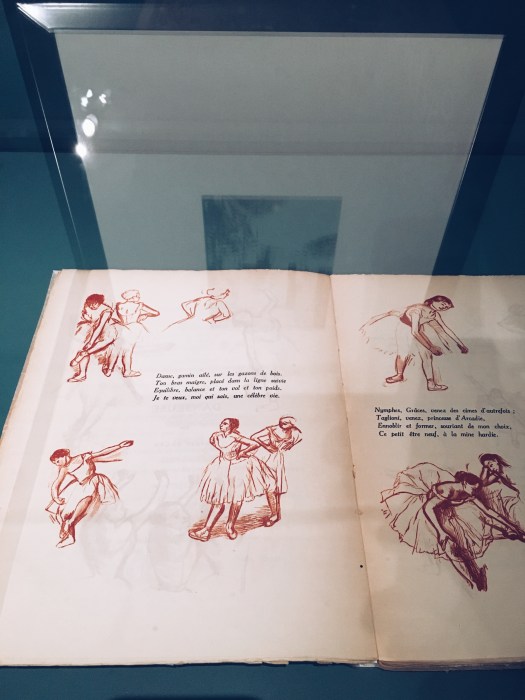
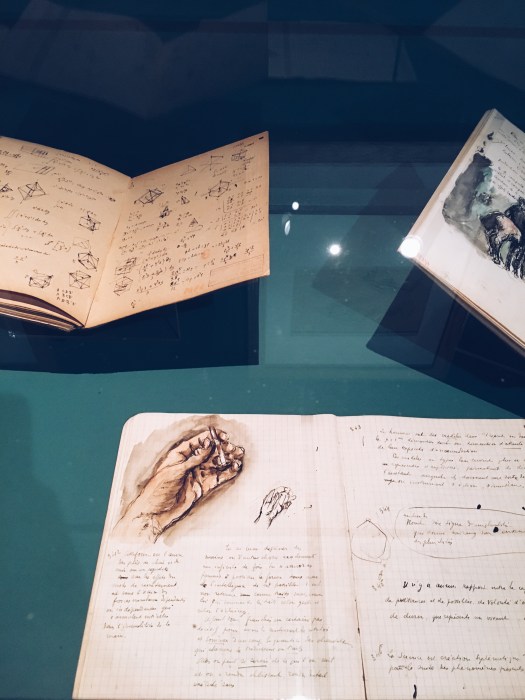
Degas as poet
Processed with VSCO with a5 preset
Valéry as illustrator


The exhibit was centered primarily around the close friendship between Degas and Valéry, one that has apparently almost been forgotten. Interspersed amongst the Degas works on display – the majority of them being works in process, or the stages of a process rather than ‘completion’ – , were fragments from Valéry’s 1937 text on the artist (and whose title the exhibit borrows for its own). Fragments conversing with other fragments, medium complementing medium, each one revealing more of itself through its attachment to or bonding with the other…there’s a certain intimacy that arises from the realization of exactly how much one person permeated into the works of another.


Processed with VSCO with s3 preset
Honestly, I don’t know if I will ever get over how much I love the…rawness of Degas’s bodies…
Processed with VSCO with u3 preset
The ubiquitous ballerina painting…


Tomorrow will be a day of preliminary Christmas shopping/scouting, closing with – finally – another night of theatre. Oh, and packing. I’m off on a quick adventure this weekend. More to follow…

82

Processed with VSCO with e1 preset
It’s almost December, and I still insist on walking everywhere.


Not too much to report today, other than another two hour walk, this time from the BNF to the high school (off Place Étoile) for tutoring, trying to walk along the river as long as possible. Result: it actually is possible if you ignore a *teeny* bit of rule breaking ;).


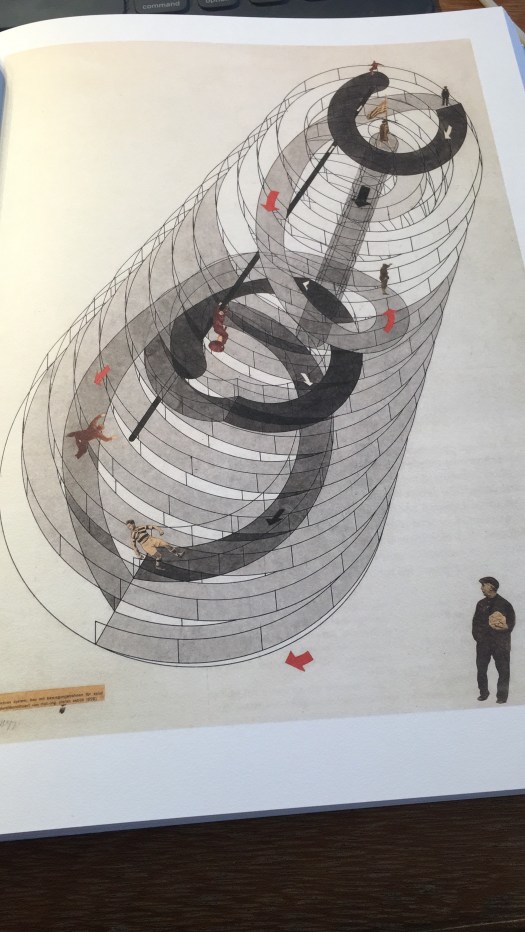
Oh, and I wanted to share this gem that I found in one of my readings today.


Behold László Moholy-Nagy’s (with Alfréd Kemény and Isván Sebök), Kinetisches konstruktives System (Système constructif cinétique). It may not look like it at first, but this is meant to be a theatre. Given its decidedly…unorthodox…style, its a wonder the project was never fully realized.


F2F07FDB-4E31-4AFA-90CE-3BFB6E5B8C84
In all honesty, I think it would’ve been fantastic if this had ended up being built. Upend everything!


And now for some Christmas lights.


Processed with VSCO with c7 preset

Project changes (81)

A few posts back, I mentioned how I had been feeling a bit adrift lately with regards to my research, how I was unsure about whether or not there was any point in what I was doing, whether I was just grasping at air.


Thankfully, after a very productive meeting today, I’m back to feeling somewhat grounded in something. To be honest, I think some of the unease I had been feeling these past few days had something to do with fear of plunging into another unknown.


In short: I’m abandoning my research on Genet to focus on something I have been mentally obsessing over for a while, the notion/dynamics of ‘space’ in relation to contemporary theatre. It feels weird to cast off something that has been a part of my academic journey for the past 5 or 6 years, but at one point it had started to weigh down on me more than anything. That’s the thing about this kind of work: we attach ourselves to certain elements, authors, concepts, ideas, and we wear them down until they are transformed into a burden, forward propulsion turned dead weight. I found myself trying to twist things to fit a contrived thought process that would have included his work for the sake of feeling that I thought it needed to be there rather than that it should, or that it added to anything in particular.


Besides, enough people have written on him, and I’ve never been one to retread someone else’s footsteps.


So I’m finally where I want to be, in theatre, in the now of theatre, at least with regards to theatre in Paris.


Reading is going to be infinitely more bearable from now on.


Processed with VSCO with hb2 preset
A golden latté from the café at Shakespeare and Co.


74 – 75

There are always those points when researching a (major, defining, all-consuming) project where you feel stuck.


Overwhelmed


Blocked


Unsure of where to go/what to do/what happens next


Feeling as if you’re not doing enough of what you should be doing. That you’re not reading enough – or worse, that you’re reading the wrong things for what you eventually want to produce. So would all that just be time wasted?


My project went through a bit of a much-needed house cleaning when I was in Boston, and while I am incredibly happy for that, there’s that unmistakable rush of stepping back into the wide expanse that is ‘research’ that is staring me in the face. I want to read everything but almost don’t know where or what to start with. I’m casting off some things – or actually, a certain writer – that have been my ‘anchors’ for a while, but maybe it would be more accurate to call them ‘crutches’.


Sometimes I do wonder about my capabilities to do this…thing. Whatever it ends up being. Then I remember that these sort of crises are normal – I experienced at least one during both years of my Masters programs as well as right before my Generals last year. Somewhere in the bowels of the BNF is the book/journal/text I need that will relaunch me on one of my reading ‘kicks’. I just need to find it.


Until then, there are walks at night, tacos for dinner at Candelaria (because it, unlike many other places, is actually open on Mondays) and conversations that get you to probe back into your thoughts, rehash them, remake, refresh them, bring them back into process.


I am a lioness. Hear me roar.