So…I may have inadvertently auditioned for someone yesterday…
I’m not even entirely sure how it happened, other than it was somewhat organic. I was technically at the venu in question after a colleague in Boston put me in touch with the woman directing the show that was meant to be put on that day. I say ‘meant’ because due to some issue with the technician (as in: his lack of being there), the show could not go on because no one else knew how to run the tech board (small team; it happens). After chatting with said director for a bit about my work, the subject inevitably moved to whether or not I still perform (answer: when I can/have time), and soon she was asking me if I had anything I could show her.
Thank goodness I had my monologue from my Shakespeare class ready (as well as some text from last spring’s Le Siège de Calais)!
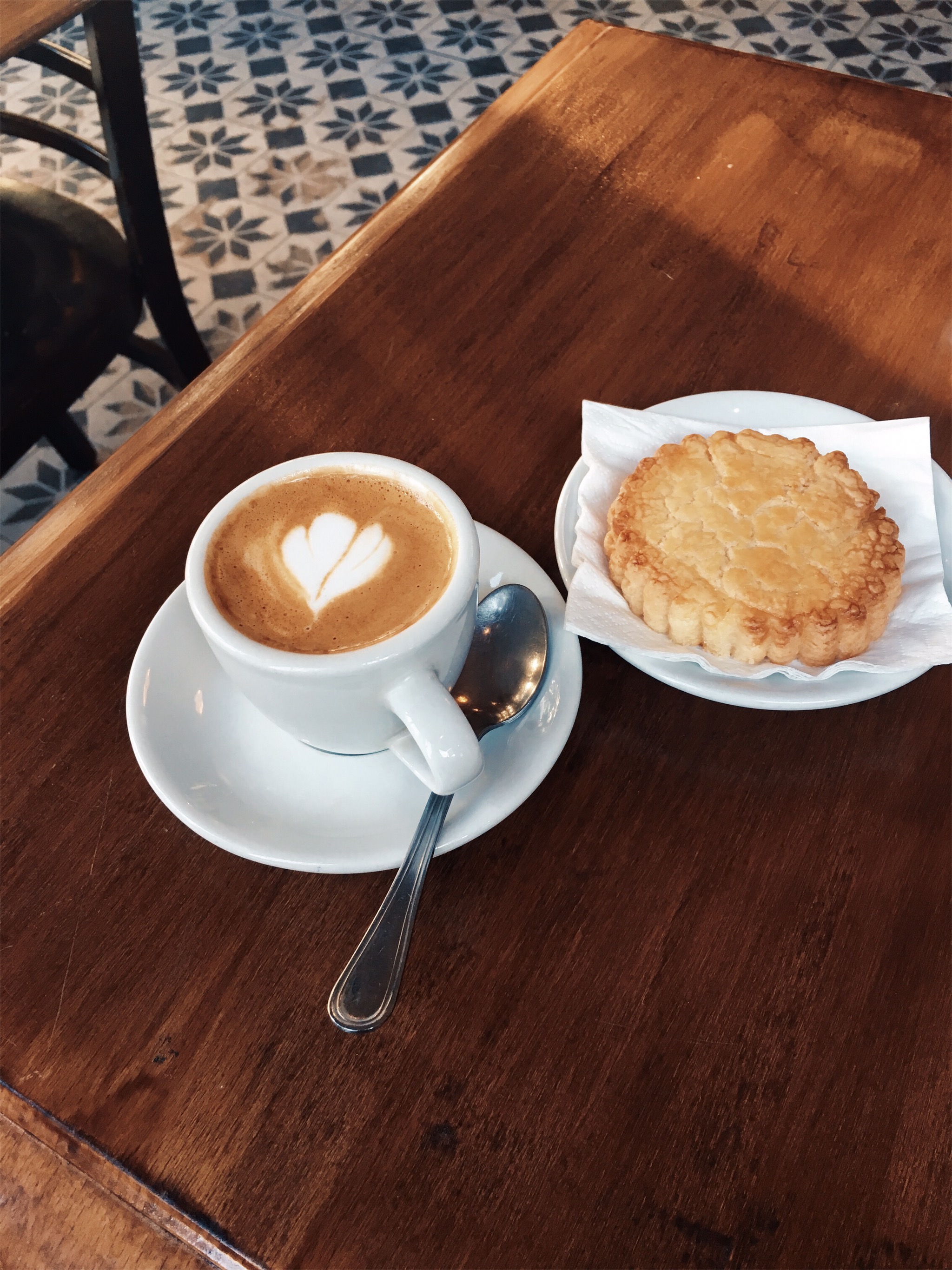
I don’t think this audition – if that’s what we want to call it – is going to lead to anything, but sometimes it just feels really good to share your art with someone, especially another art maker (something I don’t encounter as often as I would like anymore). To add to this, the managing director of the theatre, who also watched my ‘audition’, loaned me a copy of a collection of plays by one of their former resident writers. Naturally, I had to go to a café to read some of them. La Fontaine de Belleville ended up being perfect for the occasion.
Café noisette and shortbread: some of my favorite things.
Today was relatively chill with the majority of my time spent in the library reading more newspaper archives – although this time, they were dated from before the riots around the play I’m looking at now started, and I cannot tell you the level of dramatic irony that hit me every time I read something to the effect of ‘Oh, maybe all our worries about violent outbursts and reactions were unfounded’. The weather, however, was decidedly not ‘chill’, but more late summer pleasant, which made staying inside very difficult. Thankfully, I did get a good amount of walking in while on my way to a tutoring session with a student.
You know what’s fun? Reading through archived newspaper articles from fifty years ago detailing the very violent reactions against a certain play you are studying, and realizing that you could replace any number of the outraged comments with a certain orange man’s tweets and no one would be the wiser.
My, how little things have changed.
It seemed only fitting, then, that drinks on Friday night involved going the Illegal Mezcal popup at Red House, where there were various iterations of the following image: Truth
The weather has been rather…unseasonably nice lately, so this morning when I woke up, I was determined to walk from my apartment to the Comédie-Française where I was seeing a matinée at 14h. It took about an hour (so, a bit over twice as long than if I had taken the metro), but given that the show was scheduled to last for two hours, I didn’t want to risk not getting any sun time. As to the show itself…I honestly don’t know what to write because I’m still kind of speechless. Literally the fastest two hours of my life.
I say kind of because although there were elements of this show that really blew me away – the sound design in particular, especially the way music transitioned from Bach/Strauss-esq melodies to what I think was Rammstein, or if not, something like Rammstein, was especially on point – I think I am slowly coming to the realization that I don’t like the architecture/spatial dynamics of the scène à l’italienne (i.e. your basic stage setup with a proscenium, box seats, balconies, etc.). Something about the way the seats curl into the stage space makes it seem so constricting, which can be a detriment when, particularly in a show like this one that harkens back to the tragic familial downfalls of Classical theatre, you almost feel as if you want the stage to be invading your space, rather than the other way around. One of the closing images involved a character who, after having bathed in the ashes of his dead relatives, strips down, takes up a machine gun, climbs onto a platform upstage and shoots out into the audience while strobe lights flash and machine gun blares louder and louder. Knowing that the original production of this show was staged in Avignon in 2016, I can’t help but wonder if the openness of the Palais des Papes would have made that moment more impactful (not that it didn’t leave an impression because believe me, mentally juxtaposing that image with what happened in Paris two years ago definitely left its mark).
For those who are familiar with his films, yes, this play is based on Luchino Visconti’s The Damned (1969), which was itself nominated for Best Screenplay in that year’s Oscar ceremony. The premise revolves around the Essenbeck family, steel industrialists – loosley based on the Krupp family, themselves still based in Essen, Germany – who, after the Reichstag fire, choose to begin doing business with the Nazi Party, despite the reservations of the family patriarch, himself a holdover of the former German order. As you can perhaps guess from the title of the play, things do not exactly go well for them. Indeed, once all the machinations, backstabbing, betrayal, incest and walking-on-a-tightrope nervewracking paedophilia (I honestly have no other way to describe how unsettling this particular scene was), the family is but a shell of what it once was, a monster ready to openly weaponize the Third Reich. And really, there is no point in which you see this people as anything other than damned. A key element of the staging were cameras that followed them around, projecting close-ups of actors’ faces on a screen upstage as well as small screens on the sides of the proscenium, sometimes in real time, sometimes integrating pre-recorded footage (during a depiction of the Night of the Long Knives, two male actors dance on stage while behind them, their virtual selves, as well as the virtual bodies of other men, embrace in a frenzied orgy), sometimes using a stylized filter. This latter element in particular, what with the usage of mise en abyme, turned these actors into more like disjointed bodies, especially when there was a slight delay between the movements of the physical body on stage to its ‘real-time’ projected image. There was no mistaking the fact that we were in a hellscape. Sometimes video elements can be overkill. Here, they worked just fine.
But of course, with the weather being as nice as it was, I needed a bit of a pick-me-up after all that intensity, so my last stop of the day was to Montmartre for one of my favorite Paris events : the Fête des Vendanges!
Bet you didn’t know there was a working vineyard in Montmartre. Now you do.
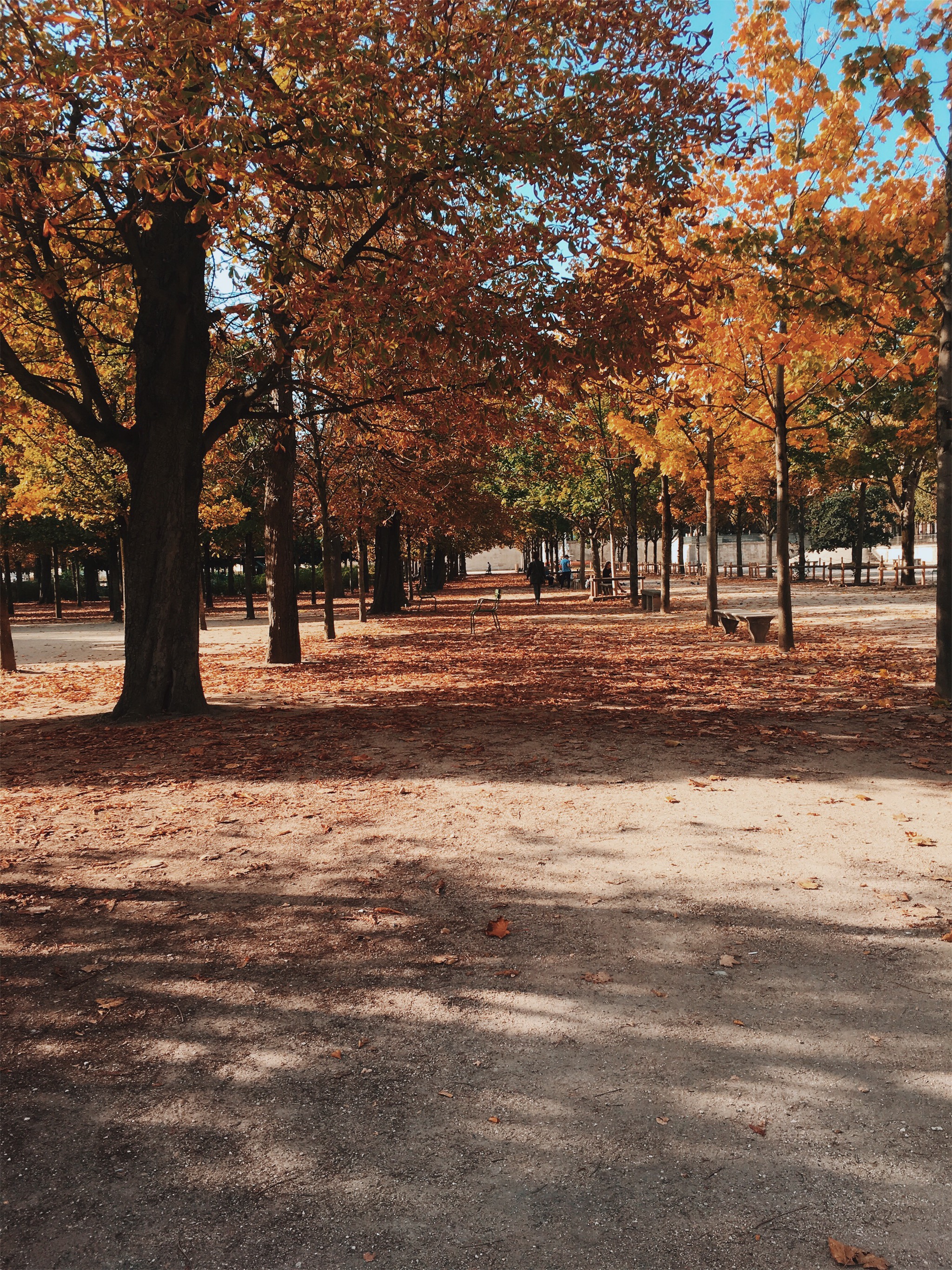
This is an annual celebration organized around the grape harvest in Paris’s last working vineyard (pictured above). Throughout the four days of the festival, the neighborhood organizes exhibits, concerts, talks, tours, workshops all with the aim of both celebrating Montmartre as well as wine/food in general. Honestly, it’s probably one of my favorite events of the year, and it serves as my annual reminder of why I love fall (although, you’d think it was late summer with the weather…). To think last time I was here, I was bundled up in a coat and scarf…
I started my afternoon with a visit to the Musée de Montmartre to check out their exhibit on Montmartre on film, as well as take a stroll around the gardens before the museum closed. The expo itself was very well organized and extensive, featuring clips, posters, props and memorabilia from various Montmartre-set films. This one, for instance, might be familiar to some: Yep, it’s the lamp (and wallpaper) from Amelie
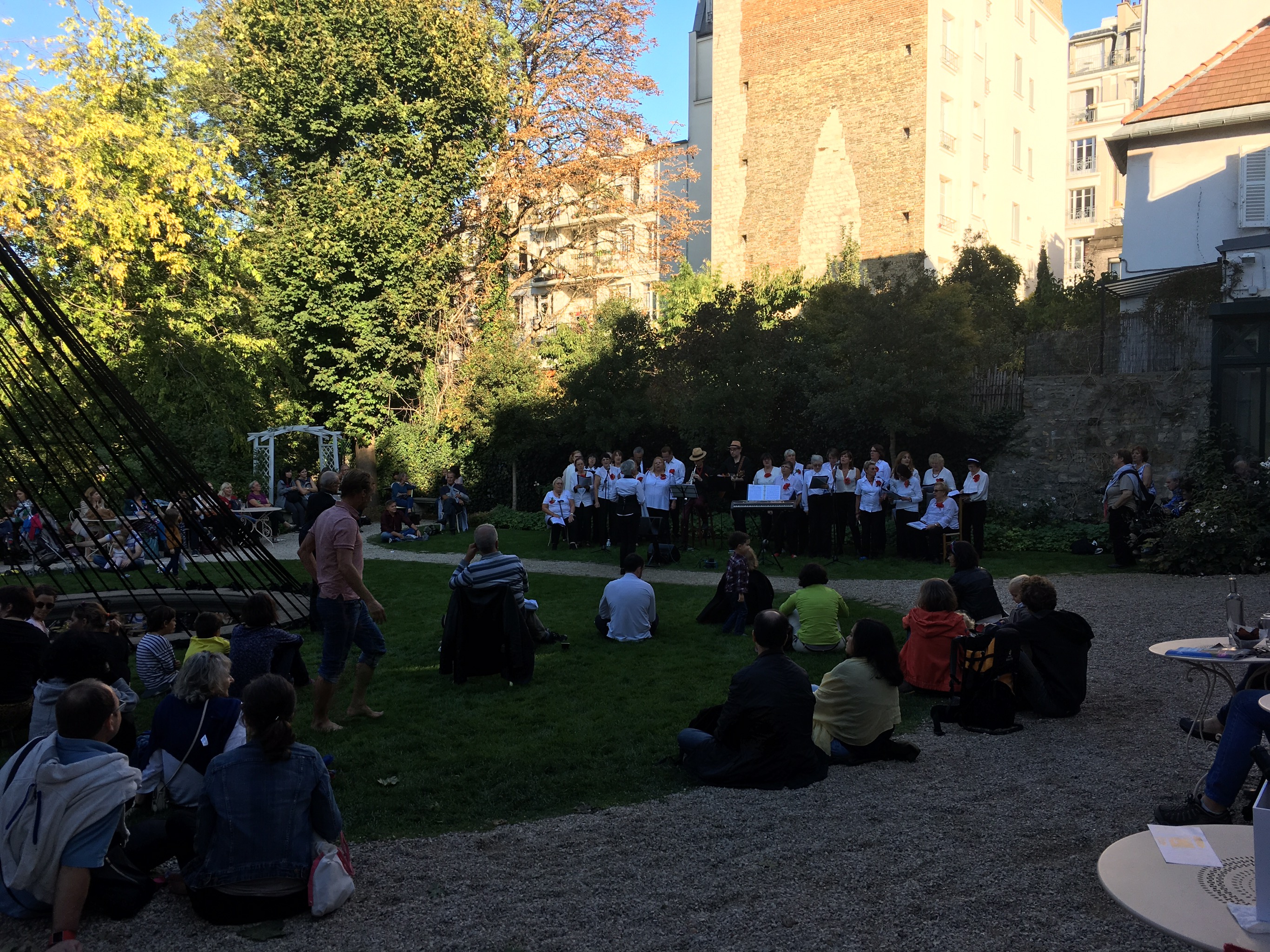
I’m glad I set aside some time for strolling around the garden as well, because I managed to catch the tail end of this little choral concert near the museum café: When the sun’s out, every spot is a picnic spot
I’m not sure if I’ve really gone into detail as to how things have changed regarding security measures in the city since the events of two years ago, but I definitely noticed a difference between this year’s Fête and the others I’ve attended. Previously, the food and wine stalls around the Sacré Cœur were open access, and crowds could just flow in and out as they pleased. This year though, that area was fenced off with two security checkpoints, one for entry, one for exiting. The downside of this – other than the disruption of the normal crowd movement – was that people tended to bottleneck up near those two points, making navigating the area a bit cumbersome at times. I have more thoughts about the État d’Urgence measures, but I’ll save those for another time.
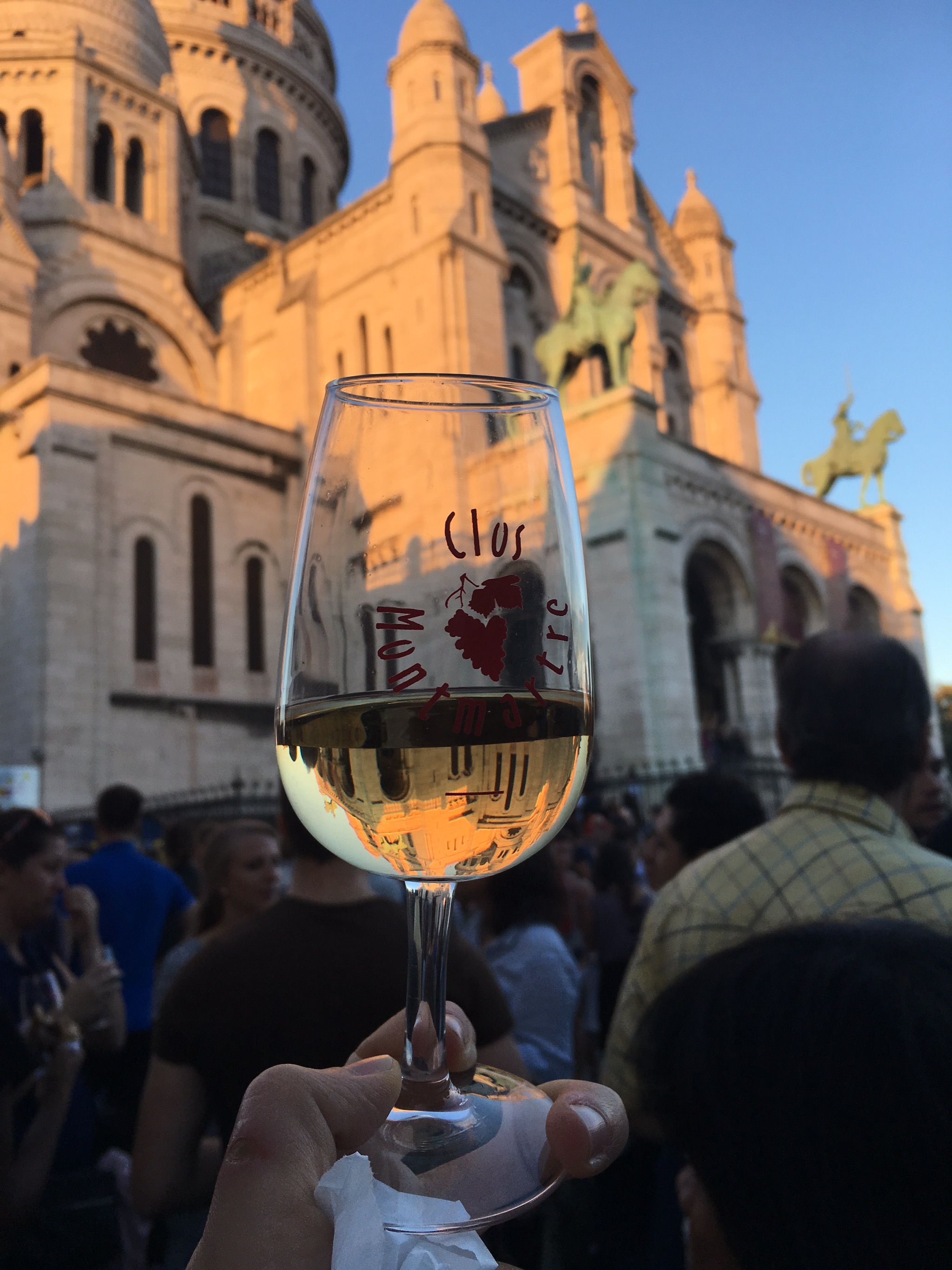
Fortunately, even with the bottlenecking, I was able to find the two friends I was meeting up with, as well as snag a commemorative wine glass: Love the amount of reusable glasses this year! Much better than all the small plastic cups from previous years.
As we were not too keen on spending the whole evening crammed amongst the crowds, the three of us pooled together to purchase a bottle of white wine (only 8eu I think!), as well as some Comté cheese, cured ham and bread, and then made our way to the back side of the church for our apéro-picnic. As I had not had anything to eat since my bowl of leftover butternut squash soup at lunchtime, let’s just say that I thoroughly attacked that cheese with all the muster my plastic knife could afford.
As if there weren’t enough nonsense in my life…
This morning, at around 7:30, I was woken up by what sounded like light tapping, as well as muffled voices. The tapping I almost shrugged off as probably coming from my neighbor – a musician who I have heard rustling about at that time of morning – but the voices were decidedly not coming from the same source. After lying half-awake for a few minutes, it occurred to me that given how repetitive it was, perhaps the knocking was not coming from my neighbor, but from my front door, though that would not explain the voices. Slowly, I get out of bed – by this time the knocking had stopped but the voices were becoming more distinct and…childlike – open my bedroom door, and discover that my television is turned on to some cartoon program.
I can say with 100% certainty that I did not turn on my television last night before going to sleep and forget to turn it off. So either there was a weird electrical glitch that caused it to turn on (which would explain why the oven clock keeps resetting), or my apartment is haunted by an asshole ghost.
Needless to say, after checking every nook and cranny in my apartment for possible intruders (unlikely since, you know, top floor/no elevator, and I verified that my door/windows/shutters were locked), I headed straight back to bed and slept until 11. Thankfully, I had planned on doing my reading from home today, so the day was not entirely wasted.
And things did pick up in the evening when I went to another performance, this time of Genet’s Haute Surveillance (Deathwatch) performed at the Studio Theatre of the Comédie Française. There’s an almost delicious sort of irony in the fact that Genet’s work is now part of the repertoire at the C.F., and to be frank, I was a bit worried about this show at first because of the institutional weight that’s attached to the venue (and also because the C.F. can be a bit too nice, or ‘clean’ at times). Turns out, my worries were, for the most part, for nothing, and especially compared to whatever it was that I saw last night, this performance made for a very engaging evening of theatre. Again, going through every single detail is slightly pointless, especially since the show is closing soon, but if I had to pinpoint one or two elements that, in my opinion, contributed to why I think it worked so well, I would have to attribute it to the lighting design as well as the use of space. With regards to the former, there was a point during the beginning of the show where the three principle actors – playing Lefranc, Maurice, and Yeux Verts (Green Eyes) – were standing downstage in a line, engulfed in darkness save for a small square of light sharply ‘cutting’ the left sides of their faces, bringing them into bright focus. The result was that it seemed as though those parts of their faces were at once part of and a-part from their bodies, existing both as concrete parts of a body as well as small floating ‘screens’, or windows into the prison cell where the play is set. In any case, it’s an interesting way to think about translating Genet’s manipulation – and later destruction – of semiotics/the sign into a theatrical medium that is not necessarily rooted in the individual actors’ performances, or even the text itself.
As to the use of space, the Studio Theatre is a bit odd in that instead of an almost black box style that one would expect from a studio, the room consists of a shallow and almost squat stage, with narrow stadium seating for the audience (and by narrow, I mean there were probably no more than 10 or 12 seats per row, and perhaps at most 15 or so rows themselves). Even before the performance started, the space itself felt very imposing, almost claustrophobic, and once the lights went down and the actors appeared – and I’m not sure whether this is due to the shallowness of the stage, the layout of the house, or both – , their bodies seemed to be almost too big. They were imposing, engulfing the space, just as the darkness and shadow was always threatening to engulf them. In some of his later works – notably The Balcony – Genet made explicit reference in his show notes to the use of cothurni (a kind of platformed shoe worn by actors in Ancient Greece) to elevate the actors and make them appear almost larger than life (or larger than human in any case). Whether that reference was on anyone’s mind when the show was being designed is a mystery, but the coincidence would not leave my mind as I watched these giant-like bodies move about in deliberate gesture on stage. Then again, that impression may have just had to do with where I was sitting (three rows from the back, house right).
I will say though that this confirms what I thought last night, namely that yesterday’s performance was going to end up setting the low bar for this season’s theatrical excursions. Hopefully, there will be more Genet to come as well.
Now I just have to deal with this potential ghost problem.
Right.
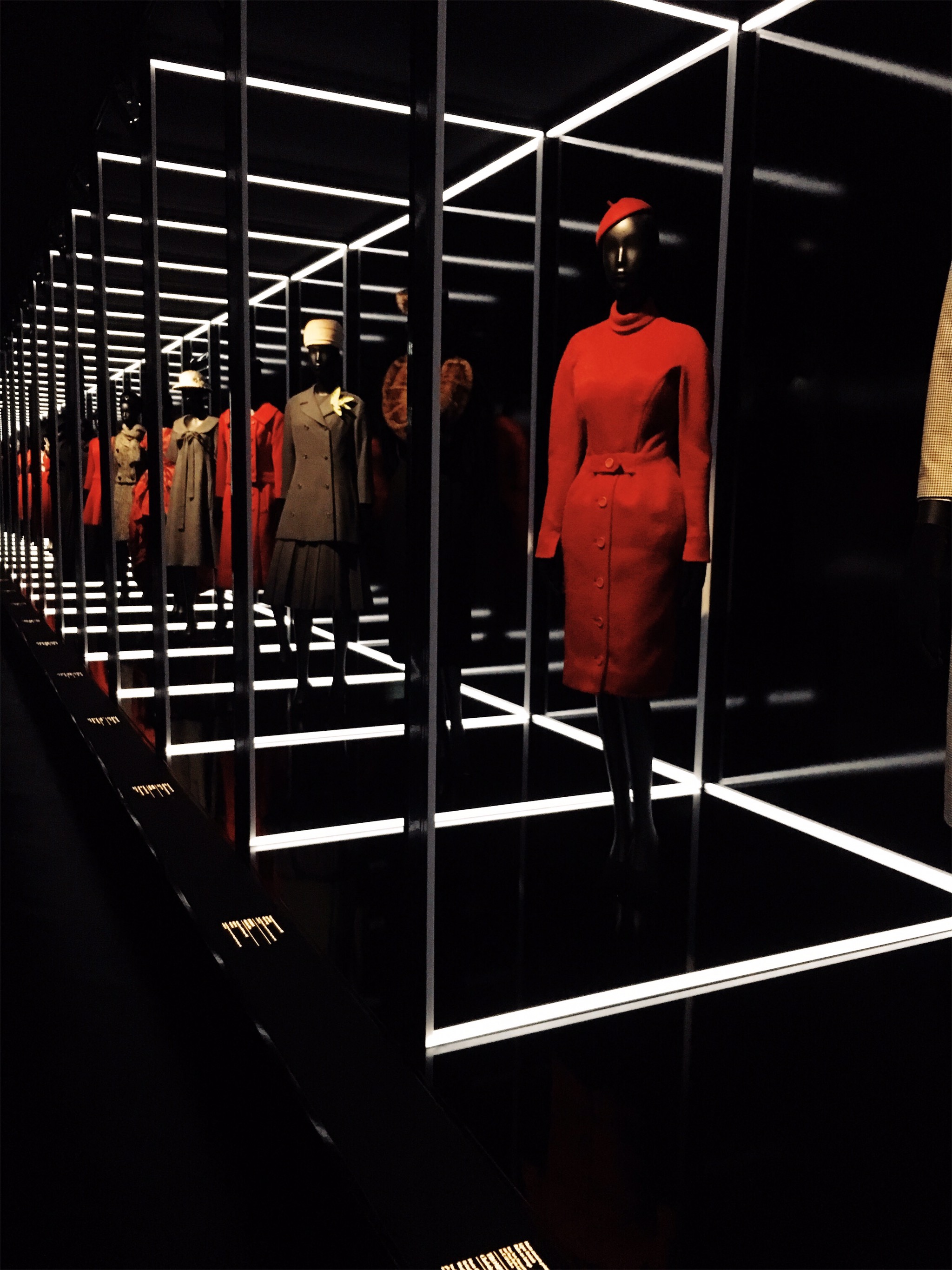
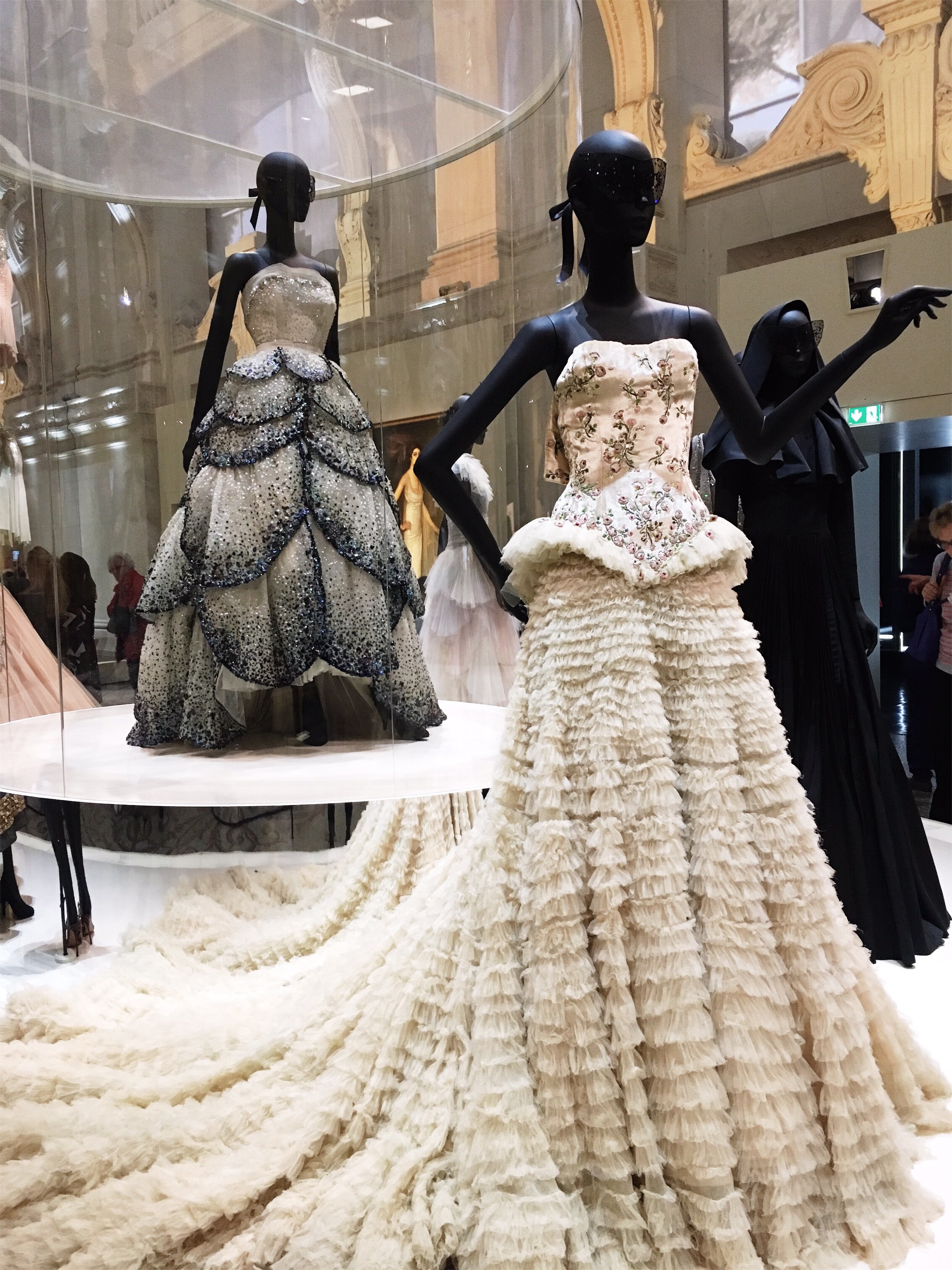
So before I get into discussing the show I just returned from seeing, I thought I’d start off with something pleasant, calming, pleasing to the eye. Like these photos I took while visiting the Dior exhibit at the Musée des Arts Décoratifs yesterday :
EleganceSymmetry, clean lines…so pleasing. Behold all these gowns that I could never hope to afford.
As an aside, the exhibit runs through at least mid-January I believe, so if you are in the area during that time, I highly recommend checking it out (be sure to buy your tickets online though; the line was insanely long for non-ticket holders).
Now onto this evening.
I think I mentioned in my introductory post (or in one of those early posts in any case) that part of my research involves going to see live theatre in the city, and trying to see what – if any – trends seem to be making headway. Because of this, I will periodically be posting my thoughts on what I see because it’s always good to share and open a discussion on live theatre, even if its ephemerality means that no one who is reading this will probably ever see the show(s) I am talking about. In any case, I’m not sure if it’s the slight optimist in me that is managing to peak out again just a little bit (surprising considering last evening was…not good mentally to say the least), but I am really hoping that tonight’s experience is a sign that things can only go up from here.
Because if not…then I am in for hours of misery and annoyance.
Tonight’s performance was an adaptation/reworking of Georges Feydeau’s Occupé-toi d’Amélie (Keep an Eye on Amelie, 1908) titled Une Hache pour briser la mer gelée en nous (literally : an axe to shatter the frozen sea within us), directed by Grégoire Strecker and performed on the main stage at the Théâtre des Amandiers, Nanterre. I had chosen to come to this show primarily because the blurb I read on it in A Nous, Paris, emphasized that the potential for disorder and chaos that underlines Feydeau’s work would be brought to the forefront, and that the mise-en-scène would see the action extracted from a turn of the century bourgeois setting to something more closely reflecting modern sensibilities.
Now look, Feydeau is fine, I suppose. He is not my favorite writer, but his plays do still carry some humor in them that can still translate well to a modern audience. Would I go out of my way to see a production of one of his plays? No. But, when I first studied abroad as an undergrad, I remember going with my theatre class to see two of his shorter works and having an enjoyable, if not particularly theoretically stimulating, evening.
Why do I say this? Because I think a reworking of Feydeau that emphasizes the trouble lurking beneath the surface, the tension that threatens to boil over and consume every one, could be an excellent way not only to revive his work, but rethink it even in its own context of théâtre du boulevard. What it does not entail, however, is 3 – yes…3 – hours of what can only be described as a frenetic mess of a play that was not even sure what it wanted to be. Oscillating between affected/stylized and more ‘realistic’ performance styles – hell, there were even some sci-fi elements thrown in with an inexplicable giant orb that showed up towards the end of act one and then just…hung out – the production struggled to find its footing for the majority of the evening, making it difficult to connect with anything that was happening. People were talking over each other at times, making the few crowd scenes almost impossible to follow, scenes involving characters switching back and forth from French to what can only be described as vaguely Slavic gibberish were set so far upstage, I almost wondered if we were supposed to be following what was happening. But, for me, the biggest offense came towards the end. One of the final images of the play is intended to be rather violent : Amelie gets manhandled and has very rough, I would say consentually ambiguous, sex with the valet of Leprince-Collette while the latter watches. Normally, something like this – especially considering that what happens immediately before is her sham(?) wedding, and so she comes before the two men in a wedding gown – would deal a final punch, but in order to do so, work had to be put in building the tension on everything that came before that moment : lingering on certain gestures, speaking deliberately, conscious of the rhythm of the words coming out, aware to an extent that it is only through personal willpower that the snap into chaos is kept at bay. Unfortunately, this work did not happen. There was, in fact, a lack of urgency or energy through much of the evening, resulting in moments meant to act as energetic bursts of built up tension reading as nothing more than following a stage direction to yell. Hell, the fact that the audience was unsure about when to clap at the end – not out of wanting to keep the suspension of disbelief hanging on for a bit, but out of genuine confusion – should say more than enough.
On the bright side, the theatre at least did provide shuttles back to Châtelet, so getting home was not as annoying as it could have been.
Tomorrow, I am actually seeing play number 2, this one hitting a liiiiiiiiittttle closer to home. Hopefully, it is an improvement on this evening.
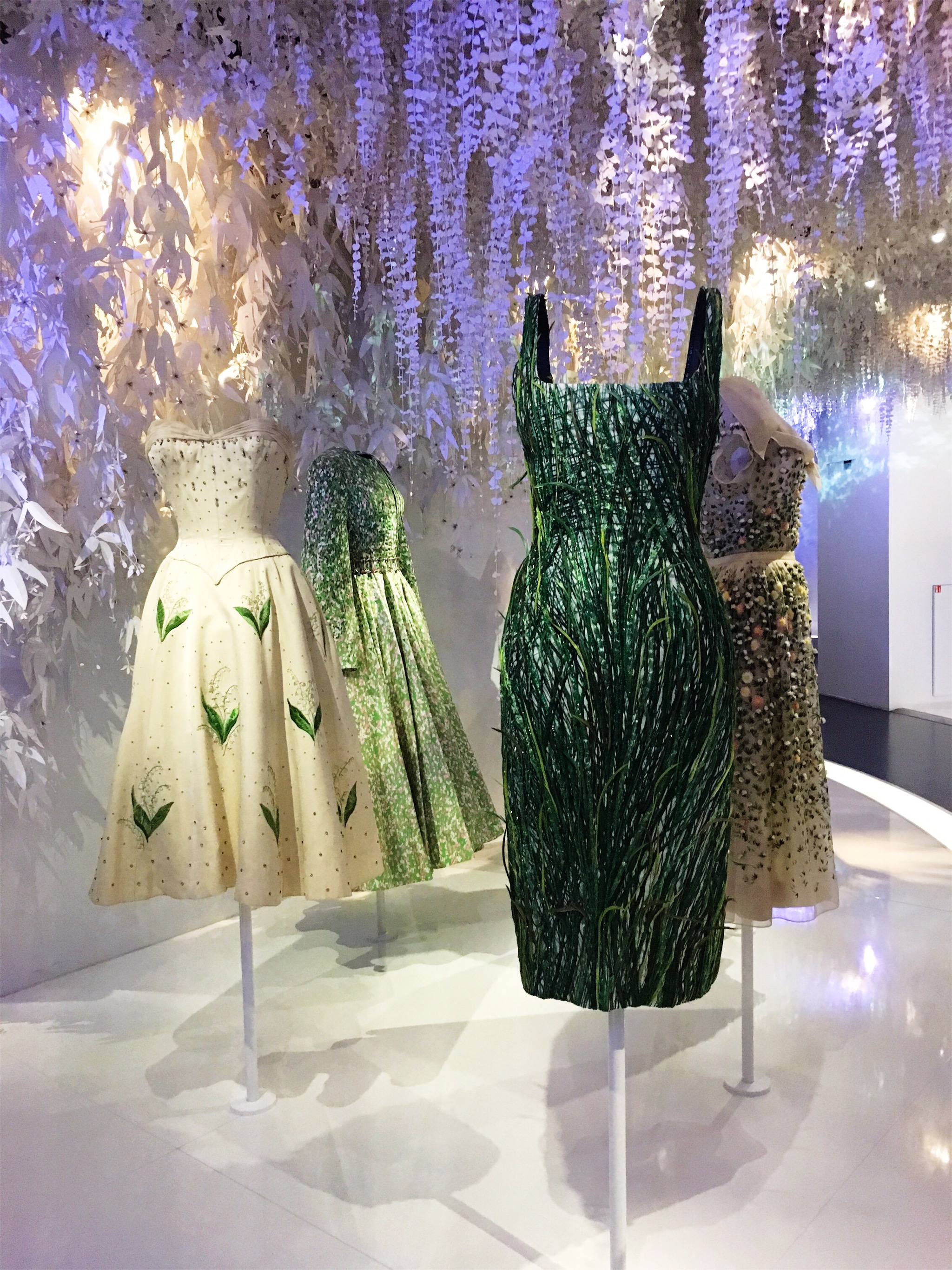
In the meantime, here’s one last picture from the Dior exhibit :





 Scènes sur Seine