Back at the Odéon after almost 60 years: Les Paravents

            To what degree can a piece of art – particularly a theatrical performance, given the degree to which it straddles the line between permanence and ephemerality – be considered independently of its own history?

            I have debated this question before, mainly with Gwenaël Morin’s 2018 production of Re-Paradise at Nanterre, then more recently with Rebecca Chaillon’s Carte noire nommée désir when it came to the Odéon last winter after its run in Avignon. In the former case, as I elaborated in my dissertation, the question arose from the fact that Morin’s staging took a moment that was spontaneous in the Living Theatre’s original 1968 production – the dancing in the streets at the close of the performance – and inscribed it as “text”, thereby also maintaining a distinct audience/spectacle divide that was otherwise blurred into something more complicit (or collaborative) fifty years prior. Conversely, with Chaillon – one of the few pieces I have made a point of seeing twice –, one thing I asked myself during the second performance I saw at the Odéon was how many people were there because of the “scandal” that the play caused in Avignon*. The gesture that sparked a reaction in the moment, in other words, becomes reduced to a kind of “artefact”, a thing that elicited a certain response once and now we wait and see if the same response will reproduce itself again rather than allowing for the gesture to regain a kind of ephemerality, existing on its own within the context of that particular performance and granting space for new, organic, spontaneous responses to it.

            Granted, with the subject of today’s post – Jean Genet’s Les Paravents staged at the Odéon by Arthur Nauzyciel – the almost 60 years between its original Paris premiere and now mean that anticipation of scandal or violent outbursts during the performance is more than just a little unrealistic. Yet, at the same time, the fact that the production is being staged at the Odéon means a revisiting of its history is all but inevitable. When the play – inspired by and written during Algeria’s war for independence, though Genet deliberately does not give any specific geographic designations in the text– first premiered in Paris in 1966 five years after its initial publication, the Evian Accords had only been signed four years prior and the memories of the conflict were still fresh. France was, in a sense, still traversing a kind of existential crisis period if we could call it that, what with the remaining fractures of WWII (including the denial – at the time – of just how many people were willing collaborators), as well as the disastrous attempts to keep a hold on Indochina as well as Algeria. Its geography was being redrawn as well as its constitution (the Fourth Republic collapsed following Algeria’s independence). Thus, when in his latest piece – staged, mind, in a State-funded theatre, a brand new concept at the time, given that the Ministry of Culture was only created in 1959 – Genet directly critiques not only colonialism in a broad sense, but also the army and Western Europe’s inflated sense of superiority**, certain groups (three guesses as to where they fell on the political spectrum) were very much not happy about it.*** 

            The outbursts that broke out both in the house and outside the theatre towards the close of the play’s initial run (think: chairs, bottles, eggs, tomatoes, and firecrackers being thrown onstage, as well as, on May 4, 1966, a pre-show protest of about 500-600 members of the right/far-right – including the group Occident – outside the theatre) rather expectedly ended up becoming synonymous with the play itself, given their amplitude. Honestly, I would say it’s almost understandable to find it difficult to think of the play – and in particular any production of it – as independent of these events. But this difficulty arguably becomes more pronounced once the play returns, for the first time since 1966, to the original site of conflict.

            Could this question of how to address the play’s past while allowing it to move on from it be part of the reason why it has taken so long for it to come back to the Odéon? Maybe. At the same time, I would also propose that the fact that it is an absolute monster of a piece (an unedited version would last 8 hours…and even I have my limits when it comes to “marathon” shows) and Genet’s theatre is not exactly known for being “easy” to perform/produce have made it a…let’s say…less than popular choice for directors/theatre troupes. It’s a shame, really, though, because the text is quite beautiful and its approach to notions of liberty (much like the rest of Genet’s oeuvre) merits engaging with, particularly as it can offer possibilities for thinking outside a cycle of removal-(re)installation of various systems of power that we seem to be stuck in, despite the fact that they have never truly lived up to their promise of liberation.

But enough of the preamble: what of Nauzyciel’s production?

I will freely admit I was skeptical at first. As usual, I tried not to “spoil” myself by looking too much at production photos or promotional videos, but one thing that was pretty much unavoidable was the realization that there were (almost) no screens in a play titled Les Paravents (The Screens in English). Generally, I’m not much of a “purist” when it comes to this sort of thing but given how insistent Genet himself was on the presence of screens on the stage in his own (extensive) notes on the play, their absence did give me pause – as did the giant white staircase that comprised the majority of the stage design.

Yet, if one of the reasons for Genet’s insistence on the presence of screens was that they be a constant reminder (particularly because of his insistence on their placement next to a “real” object) of the artifice and theatricality of what was happening on stage, perhaps the same effect could be produced with another visually theatrical device. Indeed, one of the first things that came to my mind when I saw the large white stairs were the movie musicals of the 1930s and 40s – think 42nd Street or just Busby Berkeley in general – whose most memorable numbers are pure spectacles of dazzling costumes and precise (and precisely synchronized) choreography. In this context, the stairs, and any other elements of the set design, are physically located on a studio soundstage, but on film, they could be anywhere, topographically ungrounded except for in an imagined somewhere – a space that cannot exist except within the fictional context of the film. They have thus become inherently theatrical. And, to return back to this particular case, to my own pleasant surprise – they mostly worked here.

Adding to this, given how much of Genet’s text (particularly towards the latter half) turns into a dialogue of sorts with the dead, one could almost go as far as to call this set piece a kind of “stairway to Heaven” to be incredibly clichéd about it. However, an ascending trajectory (a transcendence, if you will) is not a given. Indeed, there is much more emphasis on weighty, downward movement in the staging, particularly when it comes to the trio of the famille des orties. When, during the opening tableau, Saïd first enters at the top of the stairs and begins his descent, he moves, slowly, methodically, as though walking on a tightrope. This was likely a nod to Abdallah Bentaga, a young acrobat and one of Genet’s former lovers, to whom Les Paravents is partially dedicated. It is also a movement that is inherently theatrical, particularly as it further “fictionalizes” the space both in its suggestion of the existence of a tightrope, as well as the extent to which this suggestion affects the manner in which Saïd descends the stairs, moving this latter movement even further away from the “real”. 

The degree to which artifice is emphasized also extended to the costumes – a clearly false, almost plastic-looking, wig on a female colonist; the obvious padding worn by Sir Harold and Mr. Blankensee under their clothing; Warda’s wig being a clear nod to the one worn by Madeleine Renaud who played the role in the original production – as well as the props – very obviously wooden guns painted baby blue or pink for the soldiers of the colonial army; Sir Harold’s absurdly large glove that is also his informant. Yet, as with Saïd’s entrance, it is in the characters’ movements, particularly the degree to which they are de-natured, that brings a both consistent and I would say even approaching uncomfortableawareness of the materiality (or the fleshiness) of the bodies on stage engaging in a process of crafting fiction that, at times, takes them to the point where the possibilities of imagination confront the limitations of the real. The “screen” of performance and physicality, if you will. For instance, Malika, one of the sex workers in Warda’s brothel, almost always adopts the pose of Degas’s La Petite Danseuse de quatorze ans whenever she has to traverse the stage, yet in doing so, she also extends her arms behind her to their full tautness. This references, of course, the rather unnatural – or fantasized – position of the original statue, as well as draws attention to the fact that the actress herself must also stretch and hold her body in this position in order to maintain the aesthetic. It is neither subtle nor natural, in other words. Similarly, the Lieutenant – who is made up to look like Charles De Gaulle in a costuming/makeup decision that would have been almost unthinkable in 1966, but which I think it is fair to say Genet would have found rather amusing – moves very delicately, his upper-body gestures undulating and extending all the way to the tips of his fingers. In contrast, his lower half – by the way the actor carried himself – seemed comparatively heavy, as if all its force was concentrated in his pelvis. Watching him move was, in fact, almost like watching a body in conflict with itself (though I do not mean this as a bad thing – given the character, I think it works), wanting to both transcend as well as give into and embrace its more base, abject, desires.

There is, to a degree, an erotic element in the above, though this is arguably pushed further in the character of La Mère (the Mother) – who, as an aside, was probably my favorite of the evening. Like the Lieutenant, she carried her weight in her pelvis, though unlike him, she left her arms hanging low, oftentimes resting them on her thighs or even itching/rubbing at her inner thighs, notably climbing very close to the area between her legs. This inevitably draws attention to that area, thus the erotic potential of the gesture. But, like with most iterations of the erotic, the gesture gets close to but never quite reaches “completion”. At the same time, given this particular character’s status and relationship to not just marginalization but also abjection – like most other characters, she speaks a language that is (often) highly poetic structurally, but whose imagery/general content are more base if not outright scatological – this attention to her pelvic area in her manner of moving also brings attention to the fact that this region of the body is one that simultaneously evokes desire as well as secretes fluids / emits odors that could potentially repel that desire. A liminal space of a kind, in other words, one that straddles the tense line between attraction and repulsion. And, if I am being honest, I would have liked to have seen this tension leaned into a bit more generally – particularly when it comes to the question of the abject / repulsion. Perhaps it was the stark white of the stairs that seemed a bit…too…clean. However, when you have the Lieutenant speaking in one tableau about how his men should aspire to stain their clothes with mud, blood, and cum, and in another you have Warda picking at her teeth with an absurdly long hairpin and then spit a barely perceptible glob, the question does arise as to whether or not there was some kind of holding back on the part of Nauzyciel and/or the actors.

Of course, I don’t mean to suggest that they should have gone the complete other direction and just had the performers throw globs of indeterminate substances at each other for the sake of being visibly “foul”. For instance, the scene that once sparked fury in 1966 in which the dying Lieutenant is given the chance by his troops to breathe the air of his homeland (France) one more time via the latter farting in his face is here staged with the Lieutenant splayed out in the arms of his men while they perform synchronized body rolls around him, pointedly pushing their buttocks out at the end to suggest pushing the “wind” out of them and toward his face. It was both aesthetically beautiful and delightfully silly (I mean, given the play’s reputation and history as described above, it was also more or less the moment those familiar with the piece were waiting for, so it almost had to pack a bit of a punch). But, even if the abject was not more explicit, say, by punctuating the body rolls with fart noises, I found that it was nevertheless physically embraced here to a degree I thought could have been more consistent.

And since this is proving to be quite long already (granted, this play is also a beast in its own right so, it’s fitting), a final word on the question of screens.

As mentioned previously, there were no screens here that corresponded to Genet’s original vision of them, but there were several reinterpretations of screens. I alluded to some earlier when I spoke of the question of theatricality in the performance styles and gestures of the actors, but other than that, there are also four instances of the presence of screens in Nauzyciel’s staging that merit attention. The first is the screen – or rather the frame of a screen – that is lowered onto one of the steps to frame the action happening in the steps above. Here, it is the public that will inevitably “fill in” the screen, the boxed frame evoking a television set or the rim of a movie screen, both objects associated with another kind of spectacle. The second instance (though chronologically, this is the final screen to appear) occurs during the second act, which opens with a large screen lowered at the very top of the steps, with only one long vertical slit sliced in it acting as a kind of passage from one side of the screen to the other (and yes, this slit did suggest a vagina, and yes, this was very likely intentional). This screen represented the passage into the world of the dead, with each character signaling their arrival – or even, rebirth – into this realm first with a kind of shadow play from behind the screen before stepping through the slit. 

I have chosen to close on talking about these last two instances of screens together both for aesthetic reasons – specifically, these are both instances that feature screens onto which images are projected – as well as for some larger questions they left me thinking with regarding the relationship of Les Paravents to the events that were occurring at the time of its writing as well as continued critical association of the play with those events.

The first of these final instances involves the stairs themselves. Beginning towards the latter third of the first act and continuing in the second, black and white images and videos were projected onto them, though of course the structure of the steps meant that the images were also quite distorted. These images were, in fact, archival footage, taken from 1) a 1949 reportage on the landscapes of Algeria ; 2) a 1956 report concerning army reinforcements for Algeria (note: at the time the French government still considered what was happening in Algeria as a “special operation” – in case anyone else needed another example of the worst parts of history repeating themselves – rather than a fight for independence) ; and 3) footage from an August 1956 protest in Algeria. Together, they also represented the first instance of this staging directly tying the play back to Algeria, grounding (or at least semi-grounding) it where before it was geographically (and to a certain degree temporally) untethered. The characters on stage may not specify where they are, but the images superimposed over them via the projection at minimum symbolically tie them to a real, lived, historical moment. The dialogue with History continued in the intermission as well as the opening of the second act, when an actual screen is lowered and onto which colonial-era maps of Algeria are projected (during the intermission) followed by a filmed segment in which an older gentleman reads a series of letters written by a young French doctor stationed in Algeria in 1957/58 (at the opening of the second act). According to his director’s note, Nauzyciel states that his decision to bring the war more directly back into a piece that does not directly mention it is his own way of confronting a, what he terms, general amnesia (or at least the risk of one) surrounding Algeria’s war of Independence in France, given how little the subject is still discussed (at least from his perspective). The taboo of sorts that existed when Genet began writing his piece – when a blatantly obvious war could not be officially labeled as such – still hangs over the larger collective memory like a kind of sword of Damocles. Yet, even when considering the fact that, sixty years onward, this collective memory or lived experiences related to the war are slowly fading, I do wonder if this kind of confrontation with the historical / the real (even with the images being purposefully distorted in some cases) made the most sense for the context of this piece. I do not mean to suggest the images / videos were not impactful here – the content of some of the letters, particularly how laconic / blunt they were at times regarding not only how absolutely screwed the French army was, even as early as 1957, but also how aware they were regarding the use of torture against prisoners, was particularly effective, even if some of the looks the gentleman gave to the camera were a bit too on the nose. Rather, I wonder if this explicit grounding risks diluting some of the political power and potential of the text, especially when it comes to the larger questions it poses on the nature of power and cycles of dominance/submission which, while they are often later tied to historical moments, also exist independently of those moments. 

To return to the question I posed at the top of this post, there is also a part of me that finds it amusing that, in the projection of archival as well as testimonial footage of the war (among other aesthetic choices), Nauzyciel’s staging almost ends up embracing the critique lobbied at Genet by the press in 1966: that the play was a direct critique of the war in Algeria, despite Genet’s instance at the time that it was only inspired by the war, not a direct representation of it. Yet, Genet, also did later (in a letter to director Roger Blin) rather cheekily say that the play both was and was not about Algeria, and I think it is this uncertainty that the inclusion of the archival material risks losing. There is, in fact, a good deal of political and critical power in the embracing of temporal/spatial ambiguity in theatrical representation. Yes, it does mean, in a sense, that the fiction on the stage is happening nowhere, but in this negation, there is also the possibility that it could be happening anywhere, thus granting the text a freedom to speak beyond just a particular historical moment. 

For the sake of not making this thing any longer than it already is, I’ll just end things on this little nugget. Something to mentally chew on, if you will.

*For those unfamiliar: the play directly tackles questions of racism – and its intersections with gender, class, sexuality, etc. – particularly on the black female body in France in a darkly satirical tone that, in my opinion, is unfortunately too rare on stages these days. Anyway, in a surprise to no one who has been paying the remotest amount of attention to the rise of right/far-right discourses in Europe and elsewhere, during and after the performances, some of the actresses were verbally and physically harassed by white patrons. One performer in fact opted to take a break from the show for her own well-being once touring resumed following the festival. Chaillon in fact adapted the text a bit to directly acknowledge the aftermath of Avignon in the Odéon performance.

**At the same time, given that this is Genet, his critiques are also much more nuanced than what may be suggested here (I just don’t have too much time to get into that). In brief: no one “side” really escapes this play unscathed. Even the famille des Orties (aka: Saïd, his mother, and Leïla) end more or less where they started: in the lowest most abject dregs, yet Saïd and Leïla are also the only ones who receive some kind of veneration in the end, largely because of this and their general refusal to be folded into any kind of system of social order. 

***I was doing some more in-depth research on the 1966 premiere of Les Paravents prior to seeing the show for a side project, focusing especially on reactions/critiques in the press. One thing that stood out: the degree to which the discourse of right/far-right has not really changed regarding things it does not like. This is both hilarious and disturbing (I’ll let those of you decide where you fall on this). 

Virginia and William

It seems odd – or off, rather – to be writing right now.

But it’s also the first time in quite a long while that I’ve had enough down time to actually get to writing out my thoughts on what I’ve seen so far this season, so I figure I may as well just take it. 

I won’t lay out my feelings here (those who know me know exactly where I stand on this and that’s fine enough for me), but I will close with taking a second to point out the overwhelming hypocrisy that is characterizing a vast majority of media responses to current events – October 7 of course, but particularly now the siege and very likely ethnic cleansing in Gaza, as well as the (expected but no less vile) opportunistic co-opting of these tragedies by the right/far-right. 

With that, the two pieces for this post:

Another reason I am making a point of writing now is also the fact that the shows I am going to feature were – for now – the only two that left some kind of impression on me. Granted, this does not mean that it was necessarily a good one (I found both somewhat unsuccessful, but for differing reasons), but as I was saying to someone recently, after going to the theatre as often as I make a point of doing, sometimes just feeling a…thing…even if it is not overwhelmingly positive is better than leaving feeling perfectly neutral about the last hour(+) spent watching a performance. Call it an inevitable result from going to see as many things as I do, but it does take quite a bit to truly move me. 

Also, both pieces happen to be based on works of English writers…so…it kind of makes sense to write about them at once anyway.

Écrire sa vie (based on The Waves and other texts by Virginia Woolf), dir. Pauline Bayle, Théâtre Public de Montreuil, Oct. 7, 2023

I’m not entirely sure if anyone has ever asked themselves why Woolf’s work (other than possibly Orlando, but I think I have an idea as to why) has never been adapted for the stage, but should anyone in the near future find themselves pondering over this question, I would advise them to look to this piece. This is not to say that it was a total disaster – in fact there were one or two moments I found quite beautiful (the synchronized movement sequence among the six players being one of them). Rather, what it more speaks to is an inherent limit in some of Woolf’s work that, oddly enough, is tricky to translate to the stage if one is not particularly attentive to it.

I’ve talked before about the idea of the plurality of the body on stage (see: Bovary but also my dissertation + book), with particular emphasis on the fact that the body in performance on a stage is at once the body of the actor as well as that of the character(s) they are incarnating. This, one could argue, comes somewhat close to Woolf’s treatment (or destabilization/destruction) the literary subject, yet the problem with theatre is that, unlike in written fiction, one must contend with the fact that the aesthetics of stage performance still more or less insist upon a 1:1 association between the actor on stage and whatever singular character they are playing in a given instance. Flowing in and out between two or several subjectivities is thus rendered almost impossible when the physical body still acting as a primary signifier for an audience. Of course, exceptions exist (see again Bovary, particularly the sequence at the end when Emma confronts Flaubert), but based on what I saw here, I think those exceptions would have to be relegated to either a small moment that reveals the – let’s say – cracks in that 1:1 representational system, or something that is constantly engaged with.

Given that Écrire sa vie is mostly based on Woolf’s The Waves, I really think it’s the latter option that should have been taken.

The piece – which begins with a bifrontal staging but then moves to a fully frontal one about 2/3 of the way through – centers around six friends who are meeting for a beach picnic to celebrate the return of a seventh friend from the army. Though it is never specified what time period we are in, the costuming, as well as the particularities of the references to war made throughout, suggest we are in the late 1930s (never mind that at one point we are all asked to join in a singalong to a modified version of “Hey Jude”). Like in Woolf’s novel, the majority of the piece centers around the friends’ interpersonal relationships, how they see one another and consider themselves as individuals within the center of it all. Unlike Woolf, however, the fluidity in stream of conscious – the almost wave-like way in which one character seeps into the story/narrative of another – is missing until the latter half of the piece. At that point – which followed a kind of air raid that destroyed the celebration – all the actors come back and semi-switch costumes. I say semi because the new outfits they wore leaned more towards borrowing colors or patterns from another costume rather than an exact copy. They then began to play a version of a childhood make-believe game they had already played earlier in the show, only this time the names they call each other are those associated with the costumes they are wearing, rather than with who they played earlier. This leads to confusion, culminating in a final moment in which each character states who they “are” while trying to “properly” identify the others.

And while I see what Bayle was trying to do here in terms of developing a commentary over the way in which our relationships with those close to us help shape who we become as individual subjects – they are, in part, the multitudes we contain, as several characters in the piece suggest – I do wonder why she chose to have this happen so late in the piece, after the 1:1 relationality between actor/character had already been established and confirmed. In some sense, having this come so late makes it seem almost forced, rather than organic or fluid as a way to harken more closely to Woolf’s text. It’s a shame, really, that it feels so stale because even amidst the tragedy of impending war, there is still a larger celebration of the randomness of life that underscores this. But I think also that for it to really have worked, the piece would have needed to lean much more intently towards the ludic element of the children’s games the actors played, destabilizing fixed identity from the start. Doing this with six actors, however, especially taking into account the randomness with which Woolf’s explorations of subjectivity – particularly through her stream of consciousness writing – flow on the page, is understandably tricky, hence my suggestion earlier on why Orlando seems to be better suited for stage adaptation (its comparatively easier, for instance, when you just need to keep track of one character who shatters the illusion of the actor’s body on the stage rather than several).

Avant la terreur (based on Shakespeare’s Richard III and other texts), dir. Vincent Macaigne, MC93 Bobigny, Oct. 8, 2023

Ah, we meet again Vincent. 

After a six-year absence from the theatre to focus more on his acting career in television and cinema – I finally watched La Flamme Le Flambeau for the first time recently, and let me tell you, his guest appearances on both were…a trip – Macaigne and his special brand of spectacular excess and destruction are back. And to get this out of the way now, no he does not seem to have tamed any of the aesthetic down quite yet. 

Now, I was going to write something much more detailed about this one (because like with Je suis un pays, I have…thoughts), but I was informed last night when I was sharing my impressions on the piece with someone who had seen it a few days after I had that since last Sunday, Macaigne has made some edits to the production. Chief among these is the reduction of the run time from 3.5 hours to 2.5 hours.

I mean, look, already the 3.5-hour runtime listed the afternoon I saw it was an improvement from the 4+ hours of his last piece, so I guess we can take this development as a sign things are moving in a…tighter…direction. At the same time, this is still a show funded largely by public money, and given how production-heavy Macaigne’s work is – as well as how strapped almost all public services are in France currently –, I do wonder if perhaps these edits could not have been made sooner. Perhaps during rehearsal? In any case, most of my notes are now useless, but there is one key moment that survived the cut that I would like to speak about, mostly because it deals with a moment in Richard III’s reign that is not detailed in Shakespeare’s play directly, but that historians are – I believe – pretty much in agreement that the last Yorkist king of England had a hand in: the Princes in the Tower.

Before getting into this, yes, Macaigne’s piece is a very loose adaptation of Shakespeare’s play – and by extension of Richard III’s reign. As such, there are some elements that deviate further from the historical record than Shakespeare’s piece does. These include the swapping of Richard’s oldest sibling, King Edward IV, with a woman, Elizabeth (that she shares a name with Edward’s wife, Elizabeth Woodville, is likely a coincidence), a character named George (no, not George Duke of Clarence…he’s still here) who seems to be an amalgamation of Buckingham and – maybe – Tyrell, and key for our purposes, the reduction of the two aforementioned princes down to just one – Andrew. 

Further deviating from Shakespeare and the historical record is the fact that though at the start of the performance the audience was commanded to close our eyes and imagine ourselves in the 1480s, there was no real adherence to historic-temporal coherence. In an early sequence – one that arguably has a sizeable bearing on the significance of the one I will get to in a moment – Richard projects videos taken from his supposed Instagram “For You” page on a series of television screens on stage. The images are all real, and if one were to watch the videos on their own, one might be momentarilyshocked at the instances of intense violence, but watching a never-ending sequence of horrific accidents makes it difficult to ignore not just how disturbing by nature these videos are, but also what our appetite for them says about us and, perhaps, our numbness to violence.

And this brings us to the prince in the Tower. 

This is the longest sequence, I believe, excepting those where someone has a monologue. The sequence happens in two camera shots. The first is backstage, where Richard goes and grabs Andrew from the cage where the boy has hidden himself and begins to strangle him. The second happens immediately after and it is on stage and almost right in front of us. Richard drags Andrew back behind a box that is up slightly stage right; however, we have cameras that are to the side and above that show him strangle him and we see that fully frontally. This is shocking. However, the message I believe that McCain is trying to get across is rather clear, and will likely be clearer now, given the extensive cuts. 

Just before the scene happened, Andrew had his own monologue. Essentially, unlike in other plays where the new generation comes out and chastises the old generation, Andrew also recognizes the fact that the older generation is one that was itself begot by violence and came up in violence. I am thinking, for instance, when George early in the play talks about how his parents would always repeat to him how life was better before he arrived. Thus, if one is coming from that violence, then what else can one expect except to continue to perpetuate violence? In any case what Andrew does is he essentially forgives or pardons the old generation. At the same time, he also makes it clear in his speech that the urgency with which the whole piece is underpinned by is not going away anywhere, that the terror that’s in the title of the piece is coming. We are about to run face first into it, and we have to act and do something and the only thing we might have working on our side is the fact that this kid is talking and showing us that there is a possible other way if only we listen to him if only Richard essentially humbles himself and gives up power willingly.

The problem, of course is that Richard does not want to do that, even though it is very obvious to him and everyone else that what he’s doing is going to lead to mass destruction. And it is as a result of this that we get Richard strangling Andrew on stage, the boy’s convulsions seen not directly, but by proxy via the overhead and onstage cameras. It’s a confrontation, in other words, not just with the violence that was also found in the images projected on the screens earlier, but also with our own gazes and thirsts for violence that keep those images popping up on our algorithms.

Thus, the implication in the killing is essentially unabashedly displaying what they generations in power now are doing or have been doing to the rest of us for the past 15 to 20 years. This gets even more interesting when considering the ages of the actor playing Richard because he is about the same age as McCain, who would be classified as Gen X because he was born in 78. This is often thought of sometimes as the more apathetic generation or the new lost generation but there is a sense of responsibility there anyway: ignorance of the violence that characterizes one’s upbringing only serves to kick the can down the road rather than break the cycle definitively. And so, we kill the canary in the coal mine, so to speak. We sacrifice the young so that the old do not need to ask questions about the stability and viability of their system. There is an urgency in Andrew’s speech, augmented further by the manner of his death. Laws of succession aside, there are strong implications for our present moment in seeing an adult strangle a child who was trying to warn him of his hubris. At the same time, Macaigne’s aesthetic is also a little bit tiring to me at this point because it’s been done over and over again. At the same time though I can see why he reverts to this because the urgency has never been heeded to. I will say this is, I do think this piece was more successful somewhat than his previous piece six years ago because it doesn’t fall into the trap of conservativism that I saw in the latter, but I’m not sure what to definitively think about it.

We’ll just have to wait and see, I suppose.

On the state of things

It never ceases to amaze me that, with regards to the history of popular revolt and revolution (especially in France), the first thing that comes to mind to many State-side is a commercialized musical.

I say this less as a way to harp on Les Mis and more as a result of a reflection on two things: the 150th anniversary of the Paris Commune and a New York Times article on theatre that I read yesterday. In the case of the former, it is rather telling that a popular movement (and let’s get more specific – one that saw the involvement of several anarchists) such as this one has joined the ranks of several others like it (not just in scope or in aim but also in the fact that it was suppressed – violently – by the powers it directly challenged and destabilized) in being largely lost in the American imagination. Then again, there are several socio-ideological reasons behind why leftist history in America tends to be pushed out, leaving only traces – symbols – behind. These symbols then get picked up, sanitized, and, divorced from their context, sold off to a public willing to buy a facsimile of a revolution, singing along to “Do You Hear the People Sing” while the image of a red flag waves in the air. It’s condensed enough to be turned into a slogan you can put on a button or a t-shirt, the illusion of being close enough to revolt while still retaining a sense of comfort that, fundamentally, not much will change once the piece is over.

To illustrate this point: I remember going to see the revival of Hair back when it returned on Broadway in 2009, and in particular, how excited I was to finally get to see something from an era I was starting to dive more into. Yet, what I most retained from that experience – and what, thinking back now, somewhat informed my approach to Re-Paradise at Nanterre a few years ago – was how empty it all felt. Holding up anti-war signs, inviting the audience up to dance on stage with the actors, extolling the merits of free love and self-expression and criticizing the war machine sending young men off to die rings more hollow in a gilded theatre space where tickets are prohibitively expensive. But nostalgia sells tickets.

This is all more or less to say that, albeit with some exception, American theatre has difficulty truly getting political. What I mean by this is that the system – as it is – fundamentally does not allow for the kind of formal and contextual reckoning that could move what goes on the stage to a point beyond consumption of “political” imagery to actual confrontation and potentially discomfort. Now, America is not unique in this (I have already spent ample time writing on my frustrations with similar trends on French stages), but I want to make this point to link to the NY Times article I read this week which concentrated on the occupation of theatres in France by performing arts students and workers that has been underway for the better part of this month.

In brief, while these occupations may on the surface seem only to be about re-opening performance spaces – that is, divorced from the reality of the pandemic – in actuality (and it is here that I believe the article should have leaned more heavily towards) the fact that they are happening at all is a direct result both of the recognition of the very real consequences that COVID and its aftermath will engender, and at the same time that these consequences did not just come out of nowhere. Rather, they are the results of what I would argue to be decades of an eroding away of public funds combined with an increased mépris for those who work in the industry. It says quite a lot, in my opinion, that the current Minister of Culture, for example, has absolutely no background in the industry (her background is in pharmacology), yet is a lover of opera, which apparently counts as a qualification.

To return to the occupation, if one were to look at the list of demands (provided here, in French), one will note that chief among them is not the mere gesture of reopening – in fact there is an explicit recognition that that is not going to solve the larger problems at hand – but rather, and this is where the Times article starts to connect, without providing much detail, back to the question of American theatre, that of labor. More precisely, the demands concern the very real worries of students and those who work in the industry (called intermittents du spectacle because of the irregular nature of their work) regarding their employment and benefits status, as well as the lack of communication from the Ministry.

(A brief side note: the Minister of Culture did speak on French radio following the start of the occupations, calling them irresponsible. Ma’am, irresponsible is not communicating with representatives from the sector your Ministry supposedly advocates for.)

Now, in non-pandemic times, intermittents are normally eligible for some unemployment benefits in periods when they are out of work, provided they complete a certain number of work hours over the course of a year (the fact that theatre jobs are as erratic and irregular as they are is largely the reason behind why the system is set up like this). However, access to these benefits can be revoked if the work hour minimums are not met. When the pandemic hit last year, the government initially declared that 2020 would be what is called an “année blanche”. In other words, given the circumstances, the work hours requirement would be waived, giving intermittents at least a little security. Crucially, however, the année blanche was set to expire at the end of August 2021, presumably under the expectation, at the time, that work would have picked back up by then (or because Macron’s government is simply not a fan of distributing monetary aid where it’s needed, but we’ll get to that in a bit). Since the theatres closed again in October after having reopened again for a hot second, there has been little to no communication with artistic directors or union representatives regarding any projections for the rest of the year. Rehearsals are still allowed to happen to some (read: minimal) degree, but this doesn’t mean much when it is impossible to know whether or not, in the end, the performance will be able to be seen at all. But more pressingly, the lack of communication also extends to whether or not there are plans to extend the année blanche beyond its original deadline, meaning that thousands of folks are suddenly finding themselves in a very precarious position.

Yet, their demands are not entirely restricted to the realm of live performance. Case in point: the demand that the government retract an upcoming reform on unemployment benefits. Intermittents themselves are not directly affected by this, but, the long and short of it is that should this reform pass (and given the right-leaning makeup of this government, this is likely), a lot of folks are going to see their unemployment benefits slashed. The post-COVID crisis is going to hit a lot of people very hard, and there’s been quite a lot written already about how, globally, the wealth gap is only going to get wider. I will not bore anyone here with my usual talk of why there haven’t been real steps (in France, but also in the US) to tax the wealthy – or better yet, actually do something about those who use Luxembourg as a tax haven to accrue more wealth than anyone would need in a lifetime – and instead close this with a final point to piggy-back on one touched on in the article.

As much as France can tout its institutional support for the arts (and it is true, it is rather generous compared to other countries), when it comes down to the people working in the arts, the actors, the professors, the directors, set / costume / lighting designers, tech crew, etc., there is a lack of consideration (by the heads of State, primarily) for the labor involved that makes the sector as rich as it is. This has been going on prior to Macron, and it will most certainly last after he’s gone, so long as the notion that some jobs are more “essential” than others persists.

Because as much as that word has become synonymous with a certain imagining of those jobs that are needed to keep things running – of hospital staff, grocery staff, postal and sanitation workers, teachers – when it comes down to concrete measures, it starts to become clear that this image of “essential” does not exactly align with reality. Public hospitals still face cuts (again, in France this has been going on for a couple decades), especially in number of ICU beds, essential, low-income workers are not always working in conditions conducive to their own safety. Hell, aside from hospital staff, everyone else mentioned – including teachers – are not as of yet prioritized for vaccines, unless they are of a certain age and/or have pre-existing conditions.

No, essential has meant that which aligns with a certain set of (capitalist / neoliberal) values for a while. It is an absolutely inhuman way to see the world, and yet here we are.

As of now, the occupation at the Odéon – itself a historical site of occupation, particularly in 1968 – is still going strong and shows no sign of slowing down. There are over 50 other theatres (and counting) across the country that have joined in. Call it the power of unions, or of the collective, but in any case, it’s the people holding the State responsible, of not waiting to be brought in to the conversation but making the conversation themselves. It is political in the sense that the people involved are, by virtue of speaking, challenging the State’s notion of “legitimized” political “actors”, of those who can or cannot have a say in policy based on the perception of their profession – and more precisely what it “brings” to the State – as “valuable”.

This is not, however, to say that this movement will lead to a glorious revolution, or a utopian reversal of the way things are done in the artistic sector. As much as I can hope for the creation of an anarcho-leftist society, this past year has also firmly cemented my cynicism. But I think, and I am having trouble wording this, that what is happening in France speaks to something that I think the arts in the US deserve in terms of recognition. There are so many folks who work in the arts back in the States whose labor is undervalued, ignored. And the lack of recognition on a federal level (to think the Federal Theatre project in the 1930s could have been a reality had FDR not nixed it…because you can’t have too much socialism, apparently) doesn’t help matters. It also does not help that the governing bodies of major theatres look almost exactly the same (because yes, any popular, labor-related movement worth it’s salt must include questions of race / gender / identity along with those of class), which, to take us back to the initial thoughts that opened the article, has a marked effect on the kinds of art that are eventually produced.

So this is what I have been thinking about on the anniversary of the Commune, on the eve of a third confinement (except this one will include unlimited outdoor time within a 10km radius), with absolutely no possibility to predict anything beyond tomorrow. I am tired, I am pissed off, and I have been this way pretty much over the past year.

But here we are.

Confinement, day 13

The loneliness didn’t fully hit me until I started baking again today.


Lots of folks on social media/in general are baking nowadays (as further evidenced by the lack of flour at the markets). It makes sense, honestly. Baking is comforting, it’s warm, sometimes sweet, rich, or just so carb-y you want to keep going back for more. It’s the kind of food that turns your tummy into a soft pillow you just want to rest your hands on in satisfaction, preferably as a precursor to a nap.


But baking–at least for me–is something that’s shared.


I used to bake pretty regularly back in Boston. This was partially due to my living situation at the time, but also having a full sized oven plus a ready group of friends/fellow grad students/co-workers who I could gift some of my goods to played a rather sizable role. The last time I really baked here was when I made my (3 layered…yeah) carrot cake for my birthday back in November. Even then, though, I had an apartment full of people ready to dig into that cake with me.


Now? The first thing I thought of when I pulled my cornbread out of the oven was ‘How the fuck am I supposed to eat this by myself?’


It’s strange for me to realize how much more pragmatic my line of thinking has become lately in light of all this. As much as I want to use this time to try out a new cake recipe or revisit a favorite cookie, I would also have to be the person consuming all that afterwords. And the more I thought about it, the more I couldn’t shake the thought that I didn’t want to be the only person eating those things.


It didn’t help today that I accidentally knocked a bit more baking soda into my batter than the recipe called for–but I wasn’t going to be throwing any of it out, of course–as well as slightly overfilled my skillet, causing some batter to bubble out during baking. I was stressed, for lack of a better word.


But baking isn’t supposed to be stressful, right?


And so when I took that pan out of the oven, and even after I tasted the cornbread and found it still tasted perfectly fine, the only thing I felt towards it was frustration.


Yes, it was partially because I was disappointed in my little blunders, but I’d be lying if I didn’t say that part of me was also disappointed that I didn’t have someone physically in the room with me to laugh about this with. It’s one thing to post about all this on Instagram after the fact; it’s quite another thing when someone else is there to react with you in real-time, and possibly help turn your mood when you goof up a bit. And to be honest, with the way things are going, that’s what I am genuinely terrified about: being alone for so long that the possibility for shared physical presence–not to mention intimacy–with someone else becomes its own kind of fantasy. Unattainable.


I ended up cutting the cornbread up into smaller pieces and storing them in a Tupperware in my fridge. I’ll have one for breakfast with some yogurt tomorrow. And the next day, and so on until it’s all done. Moderation is key for me. I am already terrified of the ramifications of this extended alone time; I don’t need to add any fears about what all this comparative inactivity will do to my own body image to the mix.


And just like that…

It’s done.


It’s done and submitted.


And now all there is left to do is wait.


To be quite honest, I am almost in a state of disbelief still that I managed to submit the thing when I did (March 13, and thank goodness the due date got pushed up). For one thing, this project has been in my mind in one form or another for the past six years. I lived with it, planned my life around it, grew with it, struggled with it…and now, it’s done.


And I almost feel adrift, as if I am not quite sure where to go from here.


To be honest, the current state of things isn’t quite helping matters. I want to celebrate this moment, but then I feel guilty for even thinking that because there is something incredibly more pressing happening in the world right now which should 100% take precedence over my feelings. I will not lie though, it is very, very, difficult to go from a somewhat egotistical place of thinking that soon you’ll get your moment to be the center of attention as people gather to hear about your research accomplishments to a place of selflessness. But I would be lying if I didn’t say that I’ve been having an easy time transitioning back into the latter, shoving the dissertation to the side and prioritizing what I could do right now to make the coming weeks (and likely months) easier for others. I want to scream and stamp my feet and throw a tantrum and make this whole thing stop for just a while, be selfish and insist that I get that final moment that’s “owed” to me.


And I am very likely not the only graduate student set to finish/defend this year who is thinking this. But I think the fact that this final step was, for me, the culmination of years of schooling, the last step before leaving the role of “student” for good has made the urge to write this all out here more pressing.


I know that all this will pass…eventually…and that things will get back to something resembling normalcy soon. But that latter part also scares me because, if history tells us anything, we will have put this all out of mind by the time normalcy comes back again. There’s a reason why hubris is such a common theme to treat in tragedy.


In the meantime, I am now a PhD candidate with a submitted dissertation. I still think it can be improved upon, but honestly, the moment that I typed the last keystroke and that I finally (finally) figured out how to deal with the whole pagination thing on Word (took way longer than necessary), I felt at once light and…a heavy emptiness. I had to take a few minutes to look at my title page and process everything after I had converted the document to a PDF just to be sure it was real. Scrolling through all the pages brought back so many memories of writing sessions at home, in Greece, at the BNF, in California, and at La Fontaine de Belleville, times when I didn’t think that this day would ever happen, when the thought of writing near 300 (yeah, not counting the front/back matter, it’s about 269 pages) pages on theatre critiques seemed impossible, never mind that I had come very close to that before during my first masters (and that one was in French, too).


But then I felt this weight hit me when I remembered that there was nothing more left to do. I had no more great project that needed dealing with in the immediate future. Of course, others will come along, but in the present moment, it’s hard to envision that far ahead.


And I also could not help but laugh at the cruel irony of the situation. It’s a shame, really, that the current pandemic had to happen this year instead of last. Social distancing and self-imposed (but INCREDIBLY necessary) isolation are, after all, the perfect times to hunker down and write something like a dissertation.


I mean, Shakespeare wrote King Lear during a plague, Boccaccio used a quarantine during the Black Death as a frame story for the Decameron, likewise for Chaucer with The Canterbury Tales.


Meanwhile, I wrote a dissertation.


Yeah. The bar is a bit high.


So what am I doing at this point? Well, other than trying to keep thoughts about the inevitable cancelling of Commencement at the end of May (still keeping my fingers crossed that it ends up happening, but then I remember who is in charge in the US right now) out of my head, I have some grading to catch up on, puzzles to do, shows to watch, and, eventually, an apartment to deep clean.


Because I might as well make my living environment look nice for the foreseeable future.


And in the spirit of the great writers of the past–and also because I would like something more creative to do–, I am going to make a point of writing in here daily. One can think of it as a social distancing journal…but public. Who knows, maybe something interesting will come out of it (though this may have to wait until the second week of this, if not earlier). Hell, given how my job is going to be organized these next few weeks, this may just end up being a review of what it’s like to teach on Zoom (spoiler alert: I am both curious about and dreading this).


In the meantime, I have a small pile of essays from my 10th graders that is calling my attention. One of them used the word “boobies”. I have lost all hope.


Until next time

-Wash your hands

-Stop touching your face

-STAY HOME!!

Countdown

8 weeks.


That’s all that stands between me and my dissertation defense.


It’s odd being at this point, to be quite honest. On the one hand, I am almost in shock that it’s so close, given how much time I have spent thinking about this thing. On the other hand, I have this little nagging voice in my head that’s almost poking at me to push it back. It’s not because I don’t think I’m ready (I mean, it’s pretty much a universal truth that a PhD student is never fully happy with their dissertation because there is always more than can be done). It’s more that I’m somewhat…terrified.


Because this is it. This is the last degree program I will do, the last time I will be able to call myself a “student” in an official capacity (barring, of course, a second PhD, which…no). I mean, I haven’t left school since I started kindergarten in 1995. It’s been a while.


And with all these deadlines come sacrifices in other things. I’ve been seeing quite a bit of theatre since coming back from the Christmas holidays, but I honestly haven’t really felt the urgency to sit down and write about anything as much as I did last year (or even earlier this year). That’s the problem with having too much other stuff on your plate.


Full disclosure: that “other stuff” isn’t entirely dissertation related. For those (many) who haven’t been keeping up with what’s going on politically in France, there are certain major (and incredibly unequal/ill thought-out/nonsensical/etc.) changes being implemented this year that directly affect my line of work as a high school teacher (especially because the school I’m at is private but nevertheless under contract with the State to follow the national curriculum). Dealing with this mess—the strikes, the long conversations with my colleagues over what the f**k the Ministry of Education is thinking, if they’re thinking at all, and, yes, the sideline participation in some marches—has taken up a lot more of my free energy than anticipated. The dissertation, of course, is still priority number 1, but this mess has taken a close second.


Honestly, one thing that still keeps me going job-wise is the fact that I am teaching a literature course again. I always make sure I “show up” for my students, but getting to introduce a new crop to basic literary theory and comparative analysis and all the other things that make me love what I do (and which facilitate a kind of critical thinking that is becoming increasingly endangered, especially under the new educational reforms…again, I have some very choice words for the Minister of Education about this) taps into a part of my brain that always lights up in these situations, and inevitably gives me that extra oomph I need to carry on.


Then again, maybe messiness is part of the whole journey of the end of the PhD. In any case, it does match pretty well with what’s going on inside my head so…there’s that…?


It hasn’t all been nonsense, though. This past week, my sister flew over for a quick visit, and though the beginning of the week was a bit annoying because I had to work, by Thursday—my last day of work before another 2 week (yes!) holiday—, we were able to fully relax and, yes, eat so much yummy food.


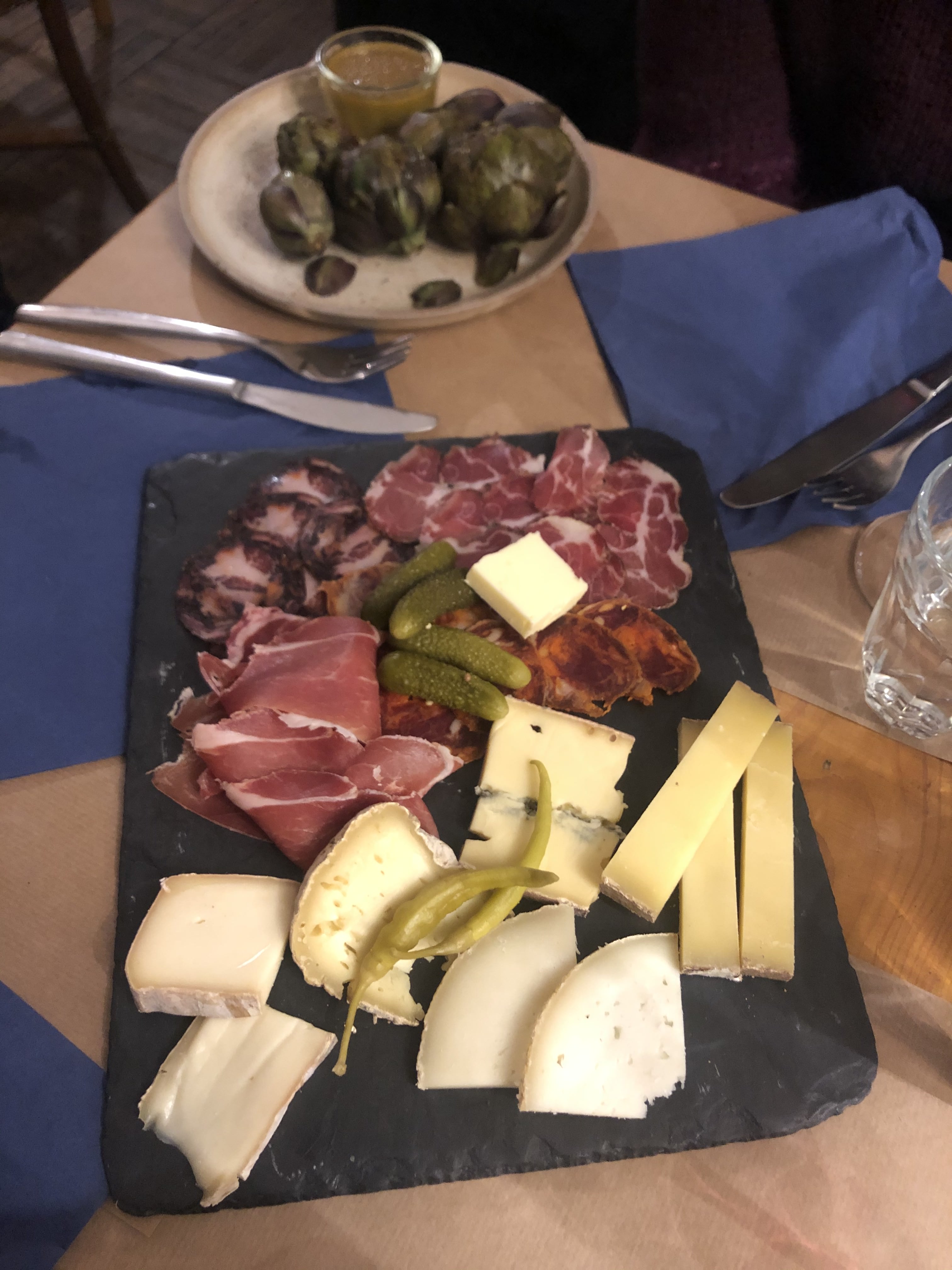
I mean, I finally managed to go eat at La Cave de Belleville, a feat in itself considering that it is just over 5 minutes from my house, yet I have never managed to do anything but get a bottle of wine from there because I always forget to reserve a table.


F6716FCF-A8B5-4221-8653-46D335A85FBC


The wine we chose that night was a very earthy red from the Jura. Upon making our selection, our server had to take a minute to double check that this was actually what we wanted, but the enthusiastic “Yes!” that Isabella (who joined us) and I answered with when she asked if we liked biodynamic wines seemed to convince her. And yes, it was indeed rather “dynamic”. The slight fizzy effervescence helped.


My sister also got to experience her first raclette dinner thanks to the machine I acquired during the winter sales (a necessary investment, as far as I’m concerned, as I have already used it three times this season).


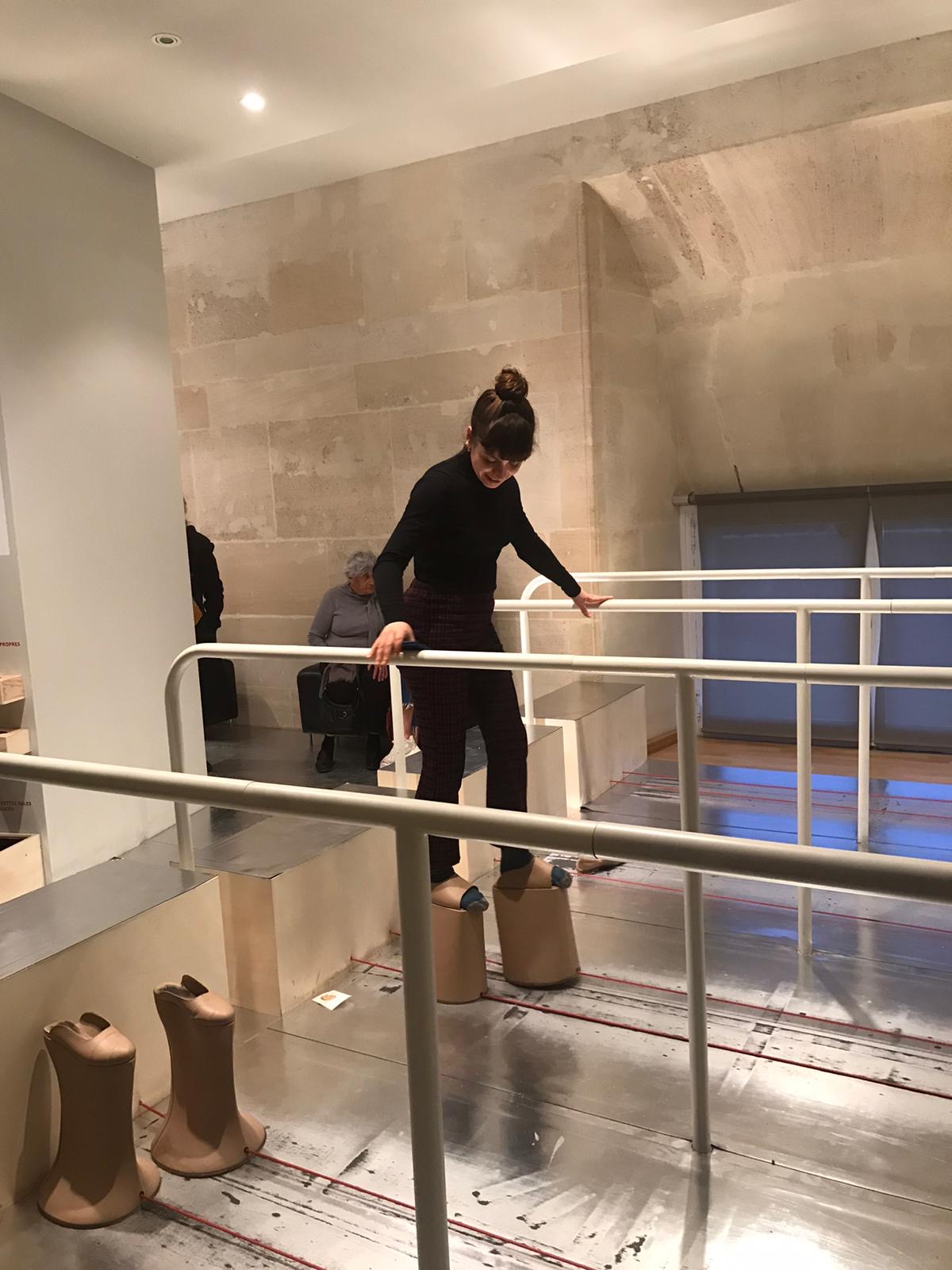
And we made plenty of time for museum and expo-hopping, including the exhibit on the history of shoes at the Musée des Arts Decoratifs, wherein I learned that, yes, there is such a thing as a too-high platform.


6CF2568E-A564-4C0C-82A1-A3184E33E81B
I know this because I tested them.


Moving forward, I promise I will try and get back to including some theatre reviews/commentary on here again (since I assume there are some people who miss it). That all might depend on how many edits (and re-edits, and re-re-edits) I will have to do between now and March 27, aka, D-Day for turning in my finalized dissertation.


Speaking of which: does anyone have any info on how to generate a table of contents on Word (or on other software)? If so, I may know someone (me) who is looking for advice.


This is getting very real.

First post for a new decade

They say absence makes the heart grow fonder.

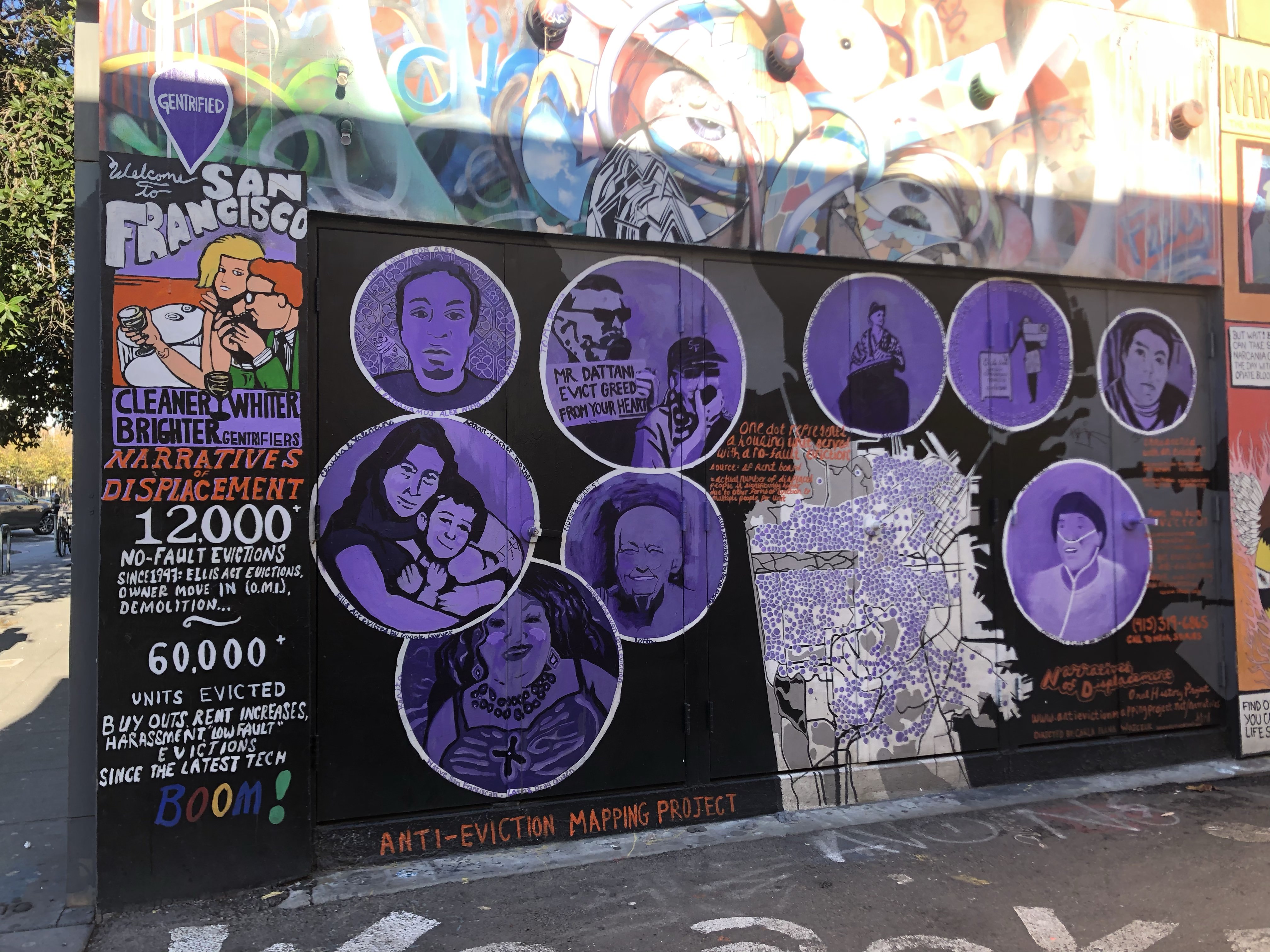
966D3AEB-DEA0-4187-8468-A71E8C60B9E3
Clarion Alley Mural Project, San Francisco


Yes, I know. It’s kind of a lame excuse, but, hey, it’s better than the usual “oops, I just got so busy with things that I forgot to write.”


Though, that bit is true.


This last month has been rather hectic to say the least. Not just with the usual end of term grading binge and holiday prepping, or with the strikes, which somewhat altered my theatergoing plans.


And yes, as an aside, I didn’t go to the theatre as often as I had planned last month, but that’s not to say I have any feelings of resentment over what’s going on. On the contrary, I actually support what’s going on, in large part because it directly affects my line of work (because of course teachers and other public servants are so privileged that our pensions must be snipped away at. Unless, of course, we’re cops…obviously), but also because, to be quite frank, in this general environment of increased neoliberalization, seeing that mass worker mobilizations can still do…something…is slightly encouraging. Slightly, only because who knows if it will actually amount to anything significant. It’s hard to stay optimistic.


In any case, it is also quite hilarious (well, infuriating but also hilarious) to read the news about this and see mostly comments along the lines of “well, yes, we understand why people are striking, but why must it be so disruptive?”. I mean, I suppose that people could just go out into the streets one day for a couple hours, make some little signs, wave them around, say a couple of slogans that could later be printed onto t-shirts or pins to be sold for the low price of X euros and then go home—perform at protest, evoke the idea, the gestures of protest—, but what good would that do?


But this is part of what the general tide has turned towards, perhaps. Going through the motions for a moment of illusory subversion, a quick rush to think “yes, I feel good about myself right now” without daring to take that extra step into more difficult territory.


It’s somewhat similar to what I’ve seen in some pieces over the last few years. It’s what Olivier Neveux categorizes as theatre that is essentially “political” in name only, when in reality, it operates within—and even to some degree, reinforces—existing power structures and dynamics.


So, yes, I’m mentally (and physically) preparing myself for a lot of cold walks in the coming days. So be it.


But beyond that, I was also sent into something of a tailspin regarding my dissertation—well, more precisely, my dissertation defense date—that kind of cracked me in the last few days leading up to the break. Chalk it up to stress, or a general feeling of being so close only to potentially have things collapse from under you, but by the time I was ready to board my flight for San Francisco, the only thing on my mind was that I needed to get out of the city for a bit. Clear my head. Relax.


And I did, relax, actually. In fact, to really hammer that bit home, I did something I had never done before for a flight to California: I upgraded to business class.


To be honest, this was always one of those things I always told myself I would do one day, but never did. Mostly because I never thought I had enough money set aside to do it, as well as just generally feeling guilty about the thought of spending money on a one-time treat like this. Besides, once I saw the “other side”, could I ever go back?


Well, friends, let me tell you: I’ve crossed the Rubicon. Business class is very nice.


And it’s not just the fact that the seat turns into a full-on bed so that I could actually sleep (okay I slept for only two hours but, hey, that’s more than zero), or that I actually had enough personal space that I could get a good amount of work done (yes, I finished grading exams because I am also very responsible when I relax). It was getting a 15-minute facial (and mimosa because I get started on my relaxing early in the morning as well) in the Air France lounge. It was getting a complementary glass of champagne on arrival, a three-course dinner with actual silverware, and then a light lunch before landing, again with actual silverware. It was the amenities kit with a toothbrush/paste, eye mask, ear plugs, and hand creams that was offered after we were all seated. Hell, it was the fucking facial cleanser in the bathroom.


I mean, let’s be honest, in brief, it was just the general feeling of being treated like a human being instead of a mass in a seat.


Now, to be fair, I have had very good experiences on Air France in economy class, so this isn’t so much a dig at them, per-say. It’s more the same general comment about air travel that’s been repeated ad nauseum over the years.


In any case, it was a lovely experience, and a good way to get started on my holiday.


And it was a good holiday too, even if I did spend the majority of it working.


I did, at least, make it out for one solo adventure in San Francisco. My parents had gone down to Orange County to visit my sister, and I elected to stay behind to finish my dissertation draft (which I did…somehow). As a sort of reward to myself, I decided a walk and a visit to the SFMOMA was in order.


And eating, lots of eating.


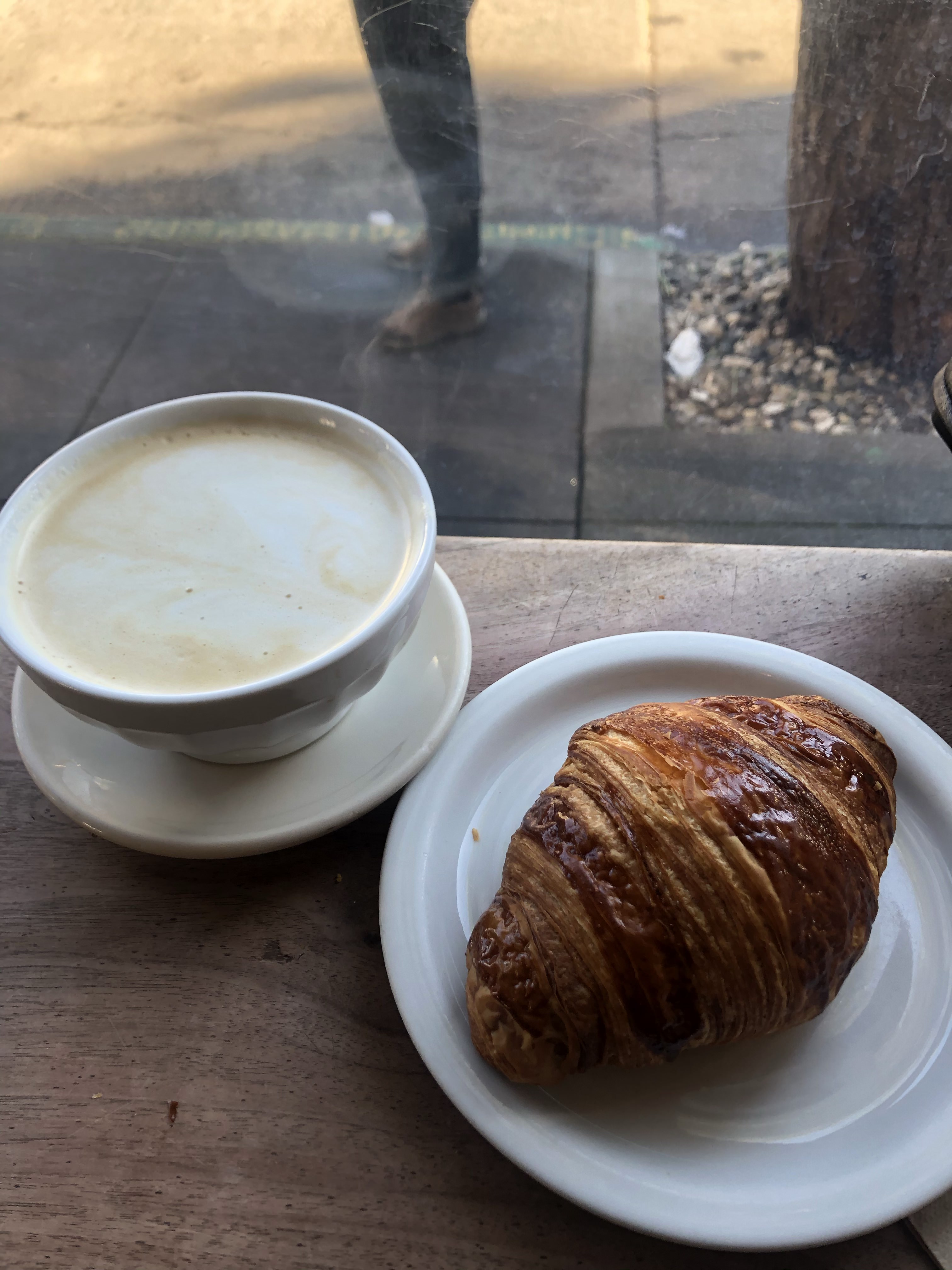
I started with a croissant and café au lait at Tartine (because I can never leave France behind entirely) before venturing on a stroll around the Mission to kill some time before lunch (aka the reason I came out here in the first place).


C1E446B9-1317-4BAE-ADEF-030F20FFD6B1
Never say no to coffee in a bowl


I mean, I actually managed to visit the namesake Mission, for once.


But yes, lunch.


Lunch was tacos.


Now, yes, the taco scene in Paris is not too terrible (special shout-out to El Nopal), but let’s be honest, it cannot beat what I can find here. And hell, I’m not even remotely an expert. I just like a good lengua taco now and then to accompany my usual order of carnitas, and also a small salsa bar.


Well, anyway. Taqueria Vallarta more than satisfied all of that. And it filled me up for my trek to the SFMOMA as well.


73D61539-3364-4759-8808-AB226261DB8C_1_201_a
Yeah, I know it’s blurry but meh, I was hungry


The museum was lovely, as usual, but nothing stood out to me so much that it left an impression. I think it was more the general feeling of being surrounded by art that made me the most happy, or that just got me out of my head for a moment.


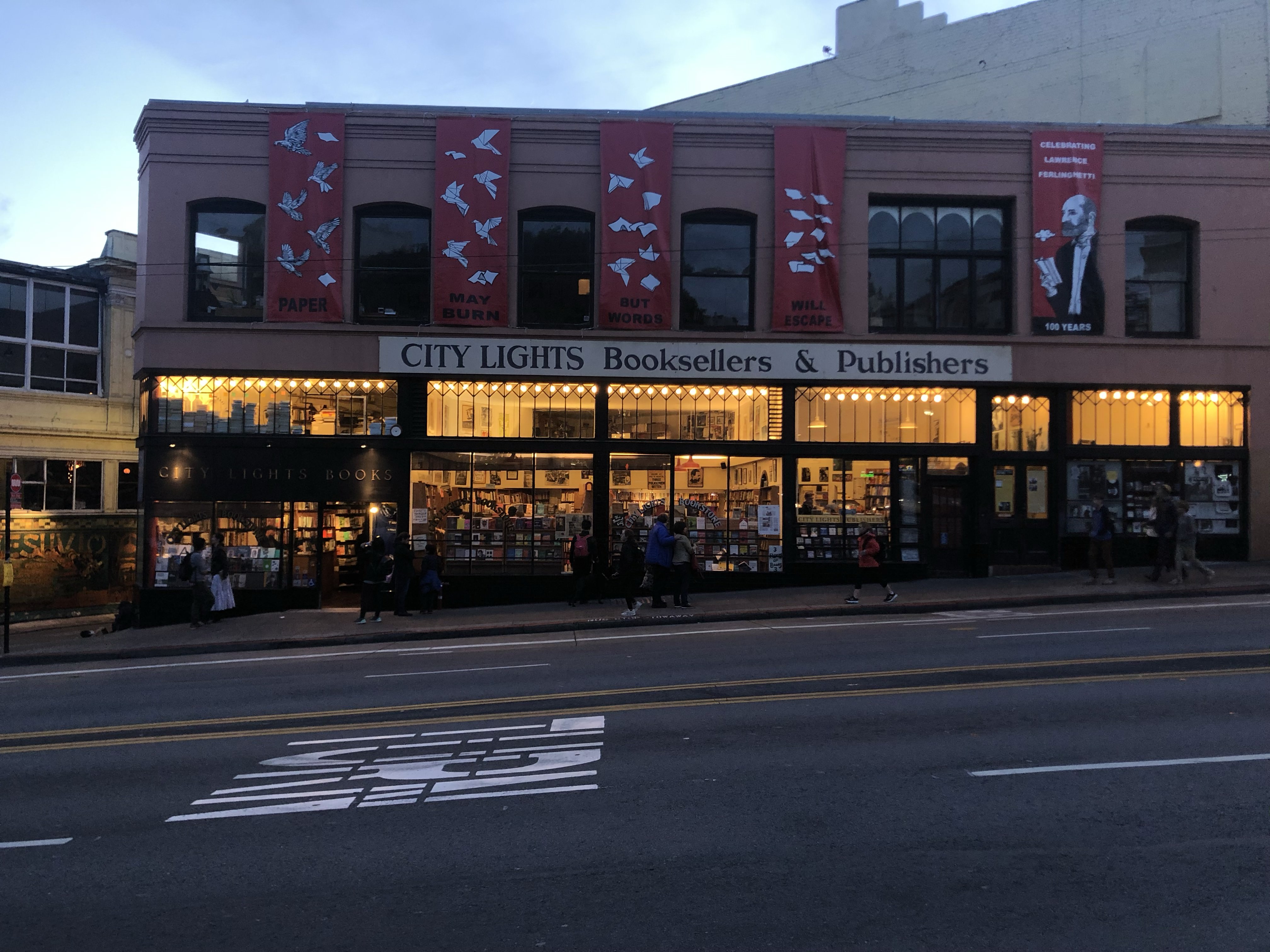
After that, I popped over to Good Mong Kok Bakery to grab a red bean cake, and then it was off to City Lights Bookstore to see if I could find anything that struck my fancy. Unfortunately, I didn’t this time around, but, then again, I’ve got two rather large books on deck, and my bookshelf is pretty much full at this point. In any case, it was nevertheless a good way to end the adventure, as well as to mark the closing of the year and decade.


1D5C2090-F990-4097-A01A-9E528D03B1AE
Sweet spot when no cars are zipping by


Yes, this is going to turn into a slight end of decade post. I say slight because I more or less did this in my birthday post (the perks of having a birthday so close to the end of the year, I guess). But I’ll add a little something here:


The 2010s for me have been, above all, the decade of Paris. Studying abroad in Paris, moving to Paris once and then back again, and spending all my time when not in Paris thinking about how I would get back. The Paris of my 2010s, and consequently my 20s, was a Paris of studying, of dealing with bureaucracy, of my first real job (which consequently, was also my first real teaching job). It was days spent at the BNF that turned into evenings. It was all-nighters (or close to them) being pulled at Reid Hall, seated behind a window in a little attic room, a pile of paper fortune-tellers acting as a testament as to how long I’d been there.


I’ve dealt with the dormitories, the landlord who got into a straight-up argument with me over giving me my security deposit back, the apartment that was too big (yep, figured out that was a thing), and then my spot now.


In short, over the past decade, as back and forth as my time here was, Paris became home.


And at the risk of getting overly sappy, I’ll end it at that. I’d say here’s to an excellent 2020, but the idiot-in-chief may or may not have just started WWIII so….eh?


At least I have whisky…


1DA94A8A-E1EC-47CE-AF45-8C3C998294E9
The only time I will ever elect to sit by a window for a flight this long

Closing out the March theatre marathon

Going to start things off with some more (very quick, I promise) musings on dissertation-writing today before moving on to other theatre-related things. Don’t worry though. This time I’m going to actually be positive(ish) about things…for once.


I had a meeting with my thesis director about a week ago, the first since our last extensive one-on-one in early July before the summer holidays officially kicked off. Was I freaking out that there would be a lot of skeptical, questioning remarks about what I’d hacked out? Yes. Did I end up having to worry about that? No…as these things usually go, apparently (convenient how the mind tends to forget this when one is ‘in the thick of it’…).


Other than planning out my next steps (which I am kind of excited about because they involve diving back into theory), one thing that was brought up was all the things I had apparently ‘done’ or illuminated in my drafts, things that, in part challenged some other established critiques of audience/spectacle relationships (and I won’t get into it here because it is a bit complicated, and this is not the space for that sort of thing…also I’m on a time crunch). These comments both come as a rather pleasant little surprise, as well as inspire some fear. Because, of course, I had no conscious intention of challenging anything when I was writing my stuff, but as those who write (dissertations or not) probably know, sometimes you just get in the zone and things come out and you don’t really stop to think about the implications of it all.


What I’m saying is, I think I might have to get into some critical analysis of my own work after this is all done, so I don’t look like a fish with its mouth gaping open during my dissertation defense a year (holy shit) from now. Writing is a funny thing sometimes.


At the end of the session, she also threw out, on a whim, a suggestion that I think I’m going to officially adopt as my title :


Contemporary French Theatre: Spatial Effects


I’m not one who easily comes up with short, not terribly wordy titles (or titles in general) for my writing projects anyway, so having this now is definitely something I don’t mind adding to my little list of ‘dissertation wins’. Also, I like puns.


Anyway, moving on to what else I’ve been up to…


Processed with VSCO with nc preset
So beautiful…(Instagram @effie143)

I tried an egg-centric (hehe) dish a week ago at brunch with a friend at Salatim, an Isreali restaurant in the 2nd arrondissement. The set brunch menu is priced at 21eur (though some add-ons, such as challah bread, will bump the price up a tiny bit…though…you kind of need bread for this meal so…yeah), and includes

  • a hot drink (coffee/tea)
  • juice (orange or house lemonade)
  • a generous serving of various salads and mezze topped with a portion of the dish of the day (that day the specials were something with salmon and confit lamb. We went with the lamb…because of course)
  • Shakshouka to share (yep)
  • A selection of desserts to share (including a very yummy chocolate babka)


When the waiter was explaining the brunch menu, the issue of me hating eggs came up, but I decided–because I guess I was feeling adventurous that day or something–to say to hell with it and said to put two eggs in the pan because hey, who knows?

Processed with VSCO with nc preset
We can now add this to the list of egg-things I’ve tried (Instagram @effie143)

In the end, I am glad we made that choice because the sauce the shakshouka was served in was really incredible (adding some harissa on it wasn’t such a bad choice either hehe). I did end up mixing in some of the egg white in with the sauce as I scooped it up with the (not included but really should be) challah bread, but I ended up leaving the yolk to the side. Mixing the egg whites in with the sauce was pretty alright. There was definitely a limit to how far I could tilt the egg/sauce ratio to the former but, at least I tried.


This does not, however, change my opinion on other egg-related breakfast dishes, so don’t even think of suggesting I try an omelette or poached egg or a breakfast burrito anytime soon.


Speaking of other food-related things, the day before said brunch I also met up with a friend to check out what I think is going to be one of my new favorite semi-annual events: the Salon des vins des vignerons indépendants (The Independent winemakers expo).


This event takes place two times a year, once in the fall (around November, I believe), and once in early spring. While the fall expo is held at the much larger venue at Porte de Versailles, in the southern edge of the city, this one took place at the slightly smaller–but no less lively, according to my friend who has attended several of these–Porte de Champerret. Basically, how it works is after you buy your entry ticket (normally 6eur, but I managed to snag a free pass), you check in, receive your complementary wine glass, and then proceed to roam up and down the aisles stopping at any tables that seem interesting. Rather than organize the wines by region–that is, one section for Bordeaux, one for the Loire Valley, one for Provence, etc–all the regions are kind of mixed together, allowing for, at least I think, some more spontaneous exploring or venturing out to try something new. Thankfully, for those on the hunt for a particular region, the signage above each table was color-coded, something I at least found rather helpful as the afternoon went on and I became increasingly determined to get my hands on some nice Rhône reds.


I ended up with four bottles in my ‘haul’ (honestly, my little wine cabinet thing could not fit any more than that), including an interesting white wine from the Jura region I would probably have never tried otherwise. I’ll be excited to break that one out eventually (another reason I didn’t get more wines, I don’t actually drink that much wine at home, living alone and whatnot).


And finally, before the ‘fun’ theatre commentary starts, I’m going to toot my own horn for a second and mention that about two weeks ago, I popped back over to Reid Hall to be part of a panel of former MA students, now PhDs, on how to carry out a research project, as well as speak about our own work to the current MA students. Having a rather untraditional–by comparison, at least, considering that the other two panelists were PhD candidates in history–project and trajectory did get my nerves going a bit at the beginning, but I think my choice to sort of dispense with the fact that, given the ephemerality of my corpus, I had no archives/powerpoint to show right away and move on to general advice ended up paying off. There was a nice little discussion afterwards as well, and I think that, having been in the position those students are in now six(!) years ago, hopefully we were all able to give them at least some helpful direction as they navigate the nonsense of a giant research project for the first time.


One thing that really irked me though, there was a gentleman in the audience who, the minute I went up to the podium, got up and started rifling through his bags rather loudly, as well as walking back and forth between the refreshments table and his seat. A side note: I was the second of the three presenters. He didn’t do this for any of the other two. I know it shouldn’t have, but it definitely took me aback for a minute, especially considering that I was doing this presentation after finishing a day of teaching. Honestly, if there is one thing I absolutely cannot stand, it’s when I have the floor and people are disruptive or chatty or in general, taking away my time. There was plenty of time between myself and the person who spoke before me to get up, stretch a bit, and then sit back down. Did it have something to do with the fact that I was the only woman speaking? Who knows. I’m leaning towards no, and just chalking this up to general rudeness, but holy hell my dude.


Common courtesy is a thing. Anyway…


Theatre


Qui a tué mon père, written by Édouard Louis, dir. Stanislas Nordey, La Colline, March 24. 


I’ll get this out of the way now: the answer to the question posed in the title (‘Who killed my father’, in English) is several people, or ‘the system’ in general. But this didn’t get fully addressed until towards the end of the production. The rest of the time was devoted to the solo actor–an avatar of sorts for Louis, considering the very autobiographical nature of this piece–detailing the history of his relationship with his father, a working-class man from the (formerly industrialized, recently deindustrialized) north of France, whose previous conservative and far-right leanings clashed with his son’s own politics as well as his person (Louis, like the solo character in the show, is openly gay). The end of the piece suggests that the father, in his older age, and now out of work due to a back injury, has started to come back around to the left, not only in terms of social issues, but also as a worker in the sense that, until recently, the left had been the side pictured as fighting for workers’ rights. (Xenophobia, homophobia, racism, discrimination, etc. are just some of the divisions the far-right has stoked in order to falsely paint itself as the party for the working man…unfortunately with some success).


As mentioned before, this show–which runs just shy of two hours–is performed by a solo actor, though he is not necessarily alone on stage. When the curtain rises, for instance, it sees him seated at a table facing what one assumes to be his father. The figure seated across from him, however, is not another actor, but a very realistic model (not gonna lie, it took me a while to realize that, partially because I was seated a bit further back in the room). This model has his downstage arm propped up on the table, the hand cradling his face so that it is hidden from view, and presumably, to suggest a lack of ‘connected gaze’. This image of visual disconnect (perhaps reflective of the metaphorical disconnect between father and son) carries on through the production as, during the blackouts that punctuate moments of the long monologue, other models of the same figure appear on stage, all of home facing either upstage, or purposefully away from where the actor is standing.


It’s only towards the end of the piece that the actor actually begins interacting with the models on the stage. At this point, there is a light snowfall bathing the space–or at least the square playing space on the middle of the stage–in white. One by one, the actor picks up the models–by this point, he has recounted the story behind his father’s work-related injury, as well as the bureaucratic difficulties involved with worker’s comp and getting back into/finding work at all–and gently placing them off the playing space. Once said center square is free of all objects, he begins his last, very pointed and very specific series of accusations.


Starting with the presidency of Jacques Chirac and concluding with Macron, the actor one by one names first, the sitting president, and then his Minister of Health and/or of Work. He doesn’t just recite the names either, but rather tilts his head up and cries the name into the sky, into the falling snow, slowly, deliberately, slightly pausing just before his declamation to make sure the focus shifts onto the names themselves before he continues on to recount the misdeeds of the persons behind said names. In general, the discours concerns the gradual eroding of the French social net, especially as far as the working class is concerned. The goal, as the text itself states, in presenting these grievances in such a way is to immortalize, via theatre, the names of the persons responsible for the increasingly-precarious living situations of the working class in the same way that theatre has–again, the comparison is given in the text–immortalized Richard III. The text closes by evoking the fact that the political means something very different for those in a position like the narrator’s (and by extension Louis’s) father, who are more quickly and more directly impacted by even five-euro budget increases or decreases than those of us (and this definitely includes most everyone sitting in the theatre that afternoon, including myself) for whom such fluctuations do not cause as much of a disruption.


And at the end, the son recounts a final conversation he had with his father, one in which the father concluded by saying it was about time for another revolution, for something to happen. Given the ongoing Gilets Jaunes demonstrations (a movement that still, in my opinion, needs to contend with the far-right presence, however small or not, in its ranks, despite the left’s attempts to retake control of the narrative), the timing of this was rather perfect.


Those who know me, though, will probably not be surprised at the fact that, while I agreed with much of what was being said during that final discours, I remained skeptical as to its efficacy in theatrical form (especially how very close to didactic it became, what with the reminder to audience members of France’s recent past). This is, however, based on an assumption that said discours would at least inspire reflection, if nothing else, on the part of the audience members, but how far can reflection go if it cannot then be translated into action?


I mean, in the end, the show is being performed in a venu located in a neighborhood that was historically very working-class but has recently undergone several years of change and the beginnings of a gentrification that is seeing the former working-class residents at risk of being priced out. It’s also a National Theatre. Normal ticket prices are around 30eur. For my American readers, this might not seem like a lot, given the average theatre ticket prices in many major cities, but here, that is up there. (Thankfully, I am still under 30, and even if I wasn’t, the membership card I have for this season greatly reduces the price per ticket).


Speaking of more political theatre…


Gymnase Platon: Lakhès, dir. Grégoire Ingold, MC93, March 28


So, here’s a question: if someone proposed to you to go attend a performance the first part of which consisted of a staging of one of Plato’s dialogues, would you go? A conversation on the themes addressed in the dialogue would of course follow, this evening in the presence of a professor of Classical Philosophy. As to the dialogue, other than being performed in French, as opposed to recited in Ancient Greek (thank god), there would be little done in terms of taking it from its historical moment to ours, trusting at least that the themes themselves would carry over just fine.


The idea of this production (or series of productions. There were actually three stagings of three different dialogues proposed, the first of which I missed, the second being this one, and the third being Plato’s dialogue on justice which I supposed to attend this past Saturday but didn’t because of…well…this piece) was to recreate the environment of the ancient Agora, a space of interaction, of sharing ideas, of thinking and speaking liberally. The problem with this idea, before we get into anything else, is that it is almost doomed to fall short from the start. For one thing, the fact that this production is staged–that is, that there is a text that is meant to be followed–means that the room for improvisation, for tangents, for interruption and other twists and turns of spontaneous discours is gone. There is, rather, a single group in this case–the actors–who retains vocal and ‘narrative’ dominance. Though at one point early on in the dialogue the audience is asked to vote on  which of the two sides they agree with (and this is before Socrates comes in and complicates things), other than that, our participation, our presence was regulated to that of what is ‘expected’ of a contemporary theatre audience.


Quiet, attentive, responding but silently until the signal is given that we may applaud.


Interestingly, the night I went there was also a group of high school students in attendance, one of whom was dealing with a rather nasty cough (yay changing of the seasons). At one point, his teacher asked him to step out so that his coughing wouldn’t be so distracting, but I honestly almost wished he hadn’t done that because this was supposed to be an Agora after all, right.


Also, again, a reminder, in Ancient Greece there was no rule about not talking at the theatre. People only shut up if they thought what was being performed was worth listening and paying attention to. So…yeah.


Second problem: this was something the philosophy professor in attendance pointed out, but there is the question of why stage Plato now while at the same time not try and shift the context of the dialogue, in some way, from his historical moment to ours. The question at the center of this one was that of the nature of ‘virtue’, but one thing that was not addressed in the written program (nor in the staging prior to the professor’s commentary) was the fact that the metrics by which this is measured by are incredibly different now from what they were in Plato’s day. Plato, in other words, would very likely not recognize virtue as we see it, least of which because, unlike in his day, we don’t necessarily measure worth by military victories/prowess anymore.


And quite frankly, I would have been very happy to just have a conversation/seminar session with that professor. He was an older gentleman, but he had a very pleasant voice and a very engaging manner, and he tried his best to make sure we were following his train of thought. In fact, one of the young high schoolers was particularly engaged with what this man was saying, and was very eager to pose him questions (unfortunately, he only had time to ask one of his questions before we all had to clear the space, but I saw him walk over to the professor as everyone was beginning to file out, no doubt ready to ask him the second question he had in mind right when the announcement that we had to clear out was made).


But, yeah, I’m not sure how productive as a work of theatre this was. The tri-frontal seating arrangement (later turned quadri-frontal after the actors ceded the right to speak to the professor) could, I imagine, have given an air of an environment set for exchange of ideas but…the stage/spectator power structures of who can and cannot speak and when were still there. Anyway, in brief, I wasn’t really keen on seeing this happen again on Saturday, hence why I decided to skip out on the next performance.


Evel Knievel contre Macbeth, dir. Rodrigo Garcia, Nanterre, March 29


Yeah, I honestly have no idea how to even begin with this.


Actually, no, here’s how:  in Swiss Army Man, before the screen cuts to black, a character, taking in the bizarre nonsense of everything that has just happened in front of her, takes a minute and then clearly lets forth the final line of the film


“What the fuck?”


Some key words for this piece


  • Orson Welles
  • Evel Knievel
  • Macbeth
  • Brazil
  • Tokyo
  • Japanese monster


Yep. I’m going to just…let this one marinate somewhere else for right now.


I will say though that the sound design was cool


Dying Together, dir. Lotte Van Den Berg, Nanterre, March 31


Participatory theatre. Creating community around death.


The one thing I will say about this is that they asked for audience members’ consent each and every time a new scenario or a new person to represent was proposed to them. That’s excellent. More people should do that.


Moving on though, the idea with this piece was, in brief, to approach the notion of death as a communal, constellation-creating (yes, constellations, as in stars, as in things that are connected not physically but by our perception of links or patterns in the spaces between them) phenomena rather than a solo one. To do this, three scenarios were proposed (the 2015 Germanwings crash, the 2013 sinking of a migrant caravan boat near Lampedusa and the 2015 attacks in Paris, specifically at the Bataclan) during which members of the audience were asked to represent, via their physical, not vocal, presence, various persons connected with said events. Said persons could have been victims, perpetrators of the attacks, relatives of victims/attackers, or people who may have been peripherally if not directly involved in the event itself. If, during each scenario, we agreed to represent the person (note: none of these people were named; for those whose identities were more or less known, all we were given was very basic information including sex, age, and perhaps an occupation or a tidbit of info on the person’s background), we were led to a part of the space and told to stand in a certain way and look in a particular direction. This would be our starting position, and from there, when the constellation would start shifting, we could move around a bit to explore the space, our connection to it/the person we were representing, and our inter-personal connections to each other.


Movements stayed relatively slow and consisted mostly of walking or variations of sitting/laying down and standing up. This one is still a bit fresh in my mind since I just came from seeing it, but it did make me think of some general thoughts I have about this kind of improvisational (ish) experimental theatre, especially as it relates to the question of audience integration. It is no secret that I myself love physical theatre. Viewpoints (of which this experience definitely reminded me, especially as we all started moving about the space) changed my life and appreciation for theatre when I was in college, but one thing I’ve found is that, in terms of actually doing it, the best results are produced in intimate, more private spaces, amongst a small group of people who have spent several weeks (or better, months) working together in order to be fully comfortable with the level of physical vulnerability and liberty in experimentation that is often asked of performers in these situations. In short, in my experience, integrating an audience, or transposing these experiences into a much larger–and much more temporary group–is always a risk, and never quite seems to go anywhere. I personally did not feel any connection to any of the persons I was asked to represent. What I did do, however, was spend the majority of my time watching how other people navigated around each other. Dynamic spatial relationships, yo.


Also it should probably not come as a surprise to anyone but when it came time to ask for representatives for the attacks at the Bataclan, it took a couple tries before they found the first person who consented to represent one of the three shooters. This production was first staged in Rotterdam, I believe with the same three scenarios, but there is something about bringing that particular one back to Paris (and only 3.5 years after the attacks) that made the initial refusals or hesitations of participating not terribly surprising.


Anyway, my skepticism towards the efficacy of participation/’immersion’ theatre still holds for now.


And now, I am going to take a lozenge and head to sleep. Stupid seasonal (and time) changes throwing off my immune system…


Until next time!


IMG_1990
My Saturday night…cocktails with a friend at La Loutre (Loutre = otter; the bar has otters printed on their wallpaper and it’s adorable).

Some more thoughts about the act of looking…

I honestly cannot remember the last time I managed to sit down and blog two days in a row.


Hell, other than the very first blog I started waaaaay back in January 2011 (which…holy shit was eight years ago) when I first moved out to Paris for a semester abroad, I cannot remember when was the last time I made a concerted effort to blog something, even a small thing, every single day for a duration of several months. Given how DAU-centric my last post was (and how much earlier I really should have published it…), I figured I’d give the show I saw yesterday afternoon its own space, if for no other reason that to give my thoughts some room to breathe.


Before that though, some updates:


1. I submitted my application for completion funding for the 2019/2020 academic year last Friday (Feb. 8). I honestly still cannot believe I managed to make it to that point–and let’s be real, if you had told me back in September that I would have been ready to submit this thing on time, I would have very likely thought you were crazy–, but, somehow the mess managed to pull itself together. At least now I can continue writing in (relative) tranquility without the whole ‘financial stability’ thing hanging over my head.


2. Somewhat related to the above, I’m going to be meeting with one of my committee members on Wednesday to finally get some feedback on the…gems…I submitted in the guise of chapter drafts. I’ve pretty much just accepted the fact that the whole ‘imposter syndrome’ thing is just going to keep following me around for as long as I’m doing this, so there really is no point in pretending that I am not internally kind of stressing about how that conversation is going to go. It’s not that I don’t like critiques of my work, I actually appreciate them a great deal. It’s more that there is always the risk of being told that I have no idea what I’m talking about/what I’m doing. I’ve learned to manage that kind of stress better as I’ve trudged along on this ‘journey of writing a thing that like…five people might read’, so at least there’s that :).


3.  I took myself out on a solo movie date on Friday after the application had been officially submitted. I’ve been getting slightly more comfortable with doing some things on my own again and not feeling isolated about it (the joys of adulthood: scheduling time with other people is sometimes nowhere near as easy as it used to be in uni). Case in point: I’ve also signed up to this services that organizes live music events around the city, and uses a kind of lottery system to determine who gets one of the (somewhat limited) spots on a given night. I went to my first one of these at the end of last month; going to be heading to another in 2 weeks. Making efforts to get out of the house, even when I have to fight against myself a bit, have proven to be a good thing for my overall sanity (if anything, it’s a nice distraction from the constant thinking).


Anyway, enough of that. On to what I saw yesterday…


So those who read here somewhat regularly (hello all…five of you) might remember a couple of posts back I wrote about a show I had seen at the MC93, entitled Ils n’avaient pas prévu qu’on allait gagner. As a refresher, the show centered around a group of foster kids in a group home, and one of my main critiques concerned the fact that the text, rather than being composed of transcribed conversations the production team actually had during their respective times spent volunteering at one such location–or otherwise words that, even if fictional, came directly from the kids in such a way that it allowed them to carry some agency in the communicating of the particularities/nuances of their situation–was written by a someone who occupies a status of societal privilege. In addition, the staging, coupled with the manner in which the piece was composed, centered–purposefully or not–the privileged gaze in its narrative. It would be difficult to say, in other words, that given the aesthetics of the production, the goal was to question or destabilize that particular gaze, and not, as I would argue, leave it intact for the sake of ‘presenting’ a ‘problem’ to a supposedly somewhat ‘ignorant’ audience.


It would be perhaps good to keep the above in mind as I lay out my thoughts on the piece I saw last night, one that also centered a marginalized group, but in a way that I would say was ultimately more successful in destabilizing established structures (in particular, those revolving around the act of looking or gazing). This, I would argue, is in large part due to the fact that, in this instance, those marginalized were given greater autonomy with regards to their storytelling.


Didier Ruiz’s Trans (Més Enllà), as the title suggests, centers on the stories of transgender individuals–seven, in this case–, not only in terms of their personal histories, but how they themselves relate or interpret the question of ‘gender’ and the ‘gender binary’. The seven performers–four trans women and three trans men, ranging in age from 22 to early 60s–are not professionals. Instead, much like with a previous project centered on life while in prison, Ruiz set out to meet with different folks in the trans community in Spain (and more precisely Barcelona), ultimately forming a small troupe with the seven that ultimately appear in the show. The stories they tell are all theirs, though they are not necessarily chronological.


The stage itself–this, by the way, was at the Théâtre de la Bastille–was relatively bare, save for two gauzy screens that curved upstage where they somewhat overlapped to create a sort of hallway from which the performers would enter and exit (exceptions being a few instances where the performers entered/exited by coming around the side extremities of either one of said screens). While the performers were speaking, the screens remained bare, save for the French subtitles that were projected onto them (the piece was in both Spanish and Catalan, depending on what language the speaker was more comfortable with).  The exceptions to this were a couple of transitional moments during which kaleidoscopic animations were projected onto them, a burst of color on an otherwise white stage.


The fact that there was no set script, and that the performers had a little bit of leeway in their storytelling meant that there was reasonable potential for the subtitles to not be word-for-word precise, or for things to get slightly deviated. This, however, was acknowledged in an opening subtitle text that was projected at the opening of the show, before the first performer began his speech, and, in a sense, it also acted as the first indication as to the degree of performative/speech agency that was granted to the speakers. Even while needing to maintain some sort of degree of precision or consistency, the words remained theirs.


Generally, the performance structure went as follows: one (or several) performer(s) would be on stage. They would look out at the audience for a beat before beginning their narration (one by one, in cases in which multiple performers were on stage at once). Everything was done in direct address, and though there were times in which, when multiple performers were on stage, the gazes of the non-speaking members would veer towards the person who ‘had the floor’ in that moment, the frontal, binary spectacle/spectator relationship remained relatively dominant. Whenever a performer would finish speaking, a few beats of silence would follow, during which the former speaker would fix their gaze outward, scanning the audience a bit before either they left the stage or another performer began speaking.


As I mentioned previously, one of the concepts interrogated in this production is that of the gender binary–and to go further, the notion of ‘transitioning’, of which surgeries, if any, one has done, whether one ‘passes’ or even, the inherent problems of continuing to adhere to this sort of idea, and finally, the degree, if any, to which an individual wants to distance themselves from their former identity–, and to that end, the decision to keep things starkly frontal, I would say, worked rather well in the destabilization of said binary, especially in the intimacy of the Théâtre de la Bastille.


Said destabilization mostly, I would argue, occurred in the silences. Now, I’m still kind of processing through my thoughts on how this worked, so you may all have to just bear with me for a minute as I try to organize things here. Anyway, as a prelude to this, one of the things Ruiz mentioned in his director’s note was the hope that eventually, the conversations around being trans would move beyond what does (or does not) exist between one’s legs. Namely, leaving the gender binary would involve moving past the assumption that there is a sort of endgame of ‘really’ or ‘fully’ transitioning, that one absolutely needs to have a certain set of ‘parts’ in order to be considered a ‘real’ man or woman. Never mind that this essentially erases the experiences of intersex or gender nonconforming folks, it also can pose problems to trans folks who maybe don’t want to undergo surgery, or who perhaps would like to someday but cannot afford it, or rather, cannot find a medical professional to perform it. There are several trans (and intersex and gender non-conforming) folks who have written or talked about their personal decisions to undergo or forego surgery, and if nothing else, it drives the point home (once again) that there is no one absolute way to ‘be’ a ‘man’ or a ‘woman’, that gender, much like sexuality, exists on a spectrum. Hell, the binary can be harmful to cis-folks too, but it has become so normalized, so ingrained in our society, that it is still, at least for me, somewhat difficult to imagine that we will ever fully divest ourselves from it (though I really hope I’m wrong on this).


I mean, even looking at some of the conversations surrounding legislation concerning transgender folks betrays the continued dominance of a rather invasive cis-centered discourse. I’m going to focus on how this applies in recent US legislation because that’s what I’m most familiar with but…the bathroom bills, the transgender military ban…to a certain extent those cases are based on a discourse that concerns itself primarily with what lies between an individual’s legs. And this carries forward into the way that individual may be perceived by others. This is the kind of perspective that fosters a gaze that looks for signs of ‘passing’–or inversely, signs that would ‘betray’ an individual’s ‘hidden’ gender identity (please note here, as above, the use of quotes). It retains the privilege of the cis gaze while also ensuring that the binary remains relatively untouched.


It is also precisely the kind of gaze that is called into question during the pauses in Trans….


When a performer appears on stage, even before they begin to speak, they take a moment to look out, to take in the spectators, and allow them to do the same. There is, in this, something of an acknowledgement of the fact that, at least for each performer’s first appearance, the audience’s gaze will very likely be, to a certain degree, that of a ‘sizing up’. We know that all seven of the performers are trans, but we do not know at what stage they are in their transitions, nor how they choose to identify themselves. The first silence, then, is that moment when those first gazes, those that conform to the notion of the ‘binary’ can happen. The fact that the pauses keep happening, however, especially as we learn more of each individual’s story–and though there are some common themes shared between a few, no two experiences are exactly alike–implies, in a sense, that the gaze has to change as well. That those looking must look differently, that repetitive pauses and moments of ‘looking’ bring attention to the act itself, and the positioning of those performing said act.


And this is all made even more present by the fact that those performing are speaking their own words, that they are given a voice and a platform from which to directly influence the shifts in perspective that ultimately lead to the aforementioned destabilization of the gender binary. They are granted autonomy, multiplicity; they are not reduced down to a ‘figure’ that has been filtered through a privileged gaze (though perhaps at another time, there could be a conversation as to Ruiz’s role in staging all this, in his choice of selecting the performers that he did, especially given that he is a cis-man).


Anyway, apologies again for any potential incoherence in everything I just hacked out, but I have quite a few thoughts to sort through, and I’m thinking that perhaps a few of them will have to wait to be hashed out in one of my dissertation chapters.


Much A-Dau about…something.

See that pun? Yeah, I’m pretty proud of it.


Anyway, DAU.


I had originally told myself that I would write about this immediately after attending, but since my procrastination streak shows no real sign of abetting any time soon (sigh), here I am about a week after the fact. Thankfully, however, I have talked about the experience with enough people that the thing hasn’t completely faded from my memory.


First things first, for those who want something of a primer as to what this was, here is a helpful article from The Guardian:


https://www.theguardian.com/film/2019/jan/26/inside-the-stalinist-truman-show-dau-i-had-absolute-freedom-until-the-kgb-grabbed-me


In short, this experience is the result of a years-long ‘workshop’ of sorts, which saw several people from varying walks of life–artists mostly, but also scientists, researchers, and workers–inhabit a block of Soviet-era warehouse style buildings in Ukraine in such a manner that not only did they willingly cut themselves off from the outside world, they also recreated in minute detail, a temporally accelerated version of life in the Soviet-era Eastern bloc from 1938 – 1968. All the while, the inhabitants were constantly being filmed (the article linked above goes into some detail regarding some of the ethical questions surrounding this, notably those involving some of the women who took part in the project), with the final footage edited down into just over a dozen 3-hour films. As individual works, the films are held together by thematic threads more so than a single, constructed narrative. They could, in fact, be said to resemble more ‘reality TV’ footage, as nothing is simulated (you can probably guess where some of the more problematic elements come from based on this), and inter-personal relationships are ostensibly said to have occurred more or less naturally. The DAU project, then, is a way to both show the films as well as recreate the experience of living under the intense surveillance of the Soviet era.


Or, well, at least that’s what it attempted to do.


To get this out of the way early: no, it was not a colossal failure. Though some have come out and made comparisons between this and the Fyre festival, I would be hesitant to do the same. Yes, there were problems (a number of which should have definitely been foreseen by someone on the production team, but I’ll get into that later), and yes the hype around this as being ‘revolutionary’ and ‘the thing that’s finally going to change the art world/art will never be the same after this/etc etc etc’ was premature and obviously overblown. At the same time, I would chalk those problems up to an overambitious (and self-centered) ego, rather than as the result of a blatant scam. Honestly, the reception around this probably would have been a lot better had they not tried to advertise it as an immersive experience.


Keeping all that in mind, let’s get into this.


When I initially came across the advert for the experience on Instagram, I was intrigued by the fact that not only would it be an immersive experience, but it would also be taking place in two theaters that are currently undergoing extensive construction and renovation work (the Théâtre de la Ville and the Théâtre du Châtelet). As I had yet to set foot in either of those theaters, I figured, why not do it now, when possibilities for spatial dynamics and exploration are so open?


Instead of tickets, those who wished to attend had to apply for a “visa”, of which there were three options: 6-hours, 24hrs, and unlimited access. For the first type, all one had to do was put in one’s payment info, submit a photo, and then select the date and hour they wished for their visa to ‘start’ (the expo is open non-stop throughout the duration of its run, so possibilities for entry times are…pretty much endless).


As to the 24hr and unlimited access visa, in order to acquire those, one had to agree to fill out a very personal questionnaire, the results of which would be used to generate a personal itinerary. Theoretically, those visa holders would also be granted access to an electronic device (yeah, in the spirit of the event, all phones had to be stored away in lockers before entering), that would orient them on where to go, as well as the next steps in their itinerary.


I, being a curious person (and admittedly a bit wine-happy that night), opted for the 24hr option. When I got to the questionnaire (this must be filled out before one can proceed to payment), and saw just how personal the things being asked were (think questions about your moral compass, but also, and more problematic, questions about your personal intimate relationships), I decided to lie a bit in my answers. I gave myself the profile of someone who may have possibly experienced some kind of past trauma, if only for the sake of (hopefully) testing the limits of this. Knowing what I had marked down, would that mean that the itinerary would orient me towards potentially triggering content? Would there be adequate staff or support on hand should a patron end up unexpectedly confronting a past trauma? Was I, in essence, consenting to potentially being rendered unsafe?


Unfortunately, I never got my answers to those questions because one of the things that ended up not happening was the whole ‘personal itinerary’ thing. Something about having access to our data, and how that’s a privacy issue….hmmmmmmmm…. Yeah.


Knowing that the personal itinerary thing was scrapped, I still decided to go anyway because maybe the rest of the ‘experience’ would still be worth it. Also, there were no refunds and I had already thrown down a LOT more money than I had ever thought I would for a performance in this city (thanks, wine).


Before I get into the nonsense, a couple of things I actually did like:


  • In the mezzanine hall of the Théâtre de la Ville, an area was set up with a series of small booths, covered in a heavy, metallic curtain. Inside these booths were ‘listeners’, people from different walks of life who had volunteered their time to the DAU project to sit in these booths as, one by one, visitors would come in and discuss whatever it was they wanted. I was curious about this, so I decided to put my name down at a moment when there seemed to be a lull in the wait time (oh yeah, it was pretty crowded the afternoon/evening I was there). I ended up in a booth with a nice older woman, and after the initial awkwardness was pushed out of the way–I have never put myself in a situation like this, so I literally had no idea what to say–, I, like any ‘good’ grad student, started talking about my dissertation. And the exchange was nice. Not the most incredibly, intimately personal of topics, but it was fun to flow back and forth with someone else for a bit…to bounce off my thoughts on them (because I still feel like I’m floundering and have no idea what I’m doing sometimes…figures). Originally, the idea was for all these sessions to be recorded, and, following their conclusion, for each visitor to be given the choice as to whether to erase or keep their video. Erase, and not only would that particular video be deleted from DAU’s recorded archives, but the visitor would be denied access from watching any other ‘confessions’. Keep, and the video would remain accessible to DAU and other visitors, and the individual in question would also be granted access to watch whatever other confessions they would have liked.


I think it’s pretty easy to understand why that would have caused problems, and why the whole recording thing ended up not happening (not sure if this was due more to technical issues, or to data and privacy protection laws in the EU…which, you know, someone should have looked into). For the record, just based on the nature of the conversation I happened to have, I would have probably been okay with its recording being stored in some kind of database, but I’m not sure how I would have felt about the whole ‘watch other people pour out their secrets’ thing. Besides, there would always have existed the possibility of someone consenting in error to having their data stored, but who knows how well DAU would have handled that scenario.


  • My absolute favorite thing though was getting to watch a piano concerto in the still-unfinished main theatre of the Théâtre de la Ville. Walking in and seeing nothing but concrete steps that mark out the rows of seats (and that are usually covered by carpeting) was enough to bring me back to when I saw a show at the Bouffes du Nord (a theatre that is purposefully kept more or less in the state it was reduced to following a fire), but what really sealed the deal for my love for this precise moment of the experience was what they did to the area where the stage would normally have been. As the space is still under heavy construction, the actual stage floor had not been laid yet, meaning that though the ‘skeleton’ of the proscenium was still there, there was a very large and deep pit that, in a ‘finished’ theatre would normally remain hidden. Those who have ever had the opportunity to poke around behind the scenes in large theatre houses are probably aware of the fact that below those stages–even further below any orchestra pits–is a network of scaffolding, hallways and nooks and crannies, sometimes used for storing props or equipment, other times used for facilitating anything involving trap doors. Here, though, the pit was bare, save for the pianist. So that those in the audience could watch, and not just listen, him play, a very large mirror was set up at an angle from the proscenium arch, reflecting the image of the pianist below, and giving the spectators a sort of bird’s-eye view. We, as the words painted on the walls in the pit suggested, were almost like gods by virtue of our positioning. All that aside, sitting in there, witnessing this exposure of a new kind of verticality, of a new potentiality for the use and design of the theatre space, was probably the only time I did not think about how much time was passing. I think just the simple fact of being in that space with it laid out in such a way that I knew would no longer be possible after the experienced closed and the theatre was ‘fixed up’ was enough. It was, in effect, a use of art as an opening of spatial/architectural possibilities; unfortunately, this was, as far as I could tell, the only instance where such a use occurred.


And now, on to the rest:


The spaces themselves were divided and organized thematically through the painting of words on the walls. At the Théâtre de la Ville, one could pass from ‘Motherhood’ to ‘Inheritance’, then ‘Brain’, ‘Futures’, or the aforementioned ‘Gods’. The thematic labels at the Théâtre du Châtelet were quite a bit more provocative–examples include ‘Sadism’, ‘Sex’, ‘War’, ‘Lust’, ‘Orgy’, etc–, but quite frankly did not really live up to any of the images they conjured, unless of course those images included the incredible banality of concrete. A bar in each of the two theaters served food and drink–which I did not partake in, even though a vodka or a whiskey would only have set me back 2eur, and who knows, maybe would have changed my perspective on this whole thing–and conveniently, there was also a gift shop front and center at the entrance of the Théâtre de la Ville. Yes, dear Patron Comrade, you too can complete your DAU experience with the purchase of an exhibition catalogue, a postcard, or even a delightful tin mug and/or bowl such as those that were used at the canteen.


Capitalism is fun.


Anyway…


By and large, the rest of the experience saw the majority of available spaces either outfitted as screening rooms to show the various films, or filled with even more of those metallic ‘confession booths’ described earlier (only this time, they were just…empty). An exception to this was the top floor of the Théâtre de la Ville–labeled ‘Communism’ on the handy maps that all visitors were given upon entry–which was transformed into a group of meticulously recreated Soviet-style apartments for the occasion. Think furnishings, knickknacks, photographs, clothes, basically anything to give the impression that the space had been and still was ‘lived in’. As the apartments were set up in what I am assuming normally function as administrative offices, one could peer into them from the windows that lined the hallway connecting all the apartments together. In other words, once again, any illusion of privacy, of a right to true personal space, was promptly done away with. Here one would also be very likely to encounter performers/artists who had either lived in the DAU complex in Ukraine and signed on to continue ‘playing’ their roles, or had been hired to play at being residents solely for the purpose of these exhibitions (after finishing here in Paris, DAU is set to move to London with the same concept). Visitors could engage these performers in conversation if they wished, though at times it was very possible that the latter would only speak Russian and have little to no knowledge of English or French. Verisimilitude and whatnot…or something.


One incident stood out from this portion of the experience: at the back of the hallway was a large apartment that seemed to belong to a group of traveling Romani shamans. It just so happened that when I and some other visitors wandered in, a few of them were preparing for a seance. The performers seemed to be ignoring us–though, when they spoke to one another, it was not in a language I understood, so I’m not entirely sure how our presence, or even the fact that we had the freedom to wander in and out as we pleased, factored in to their present routine–, and this sort of mutual lack of direct acknowledgement would have likely continued were it not for the fact that a fellow visitor at one point asked one of the performers if it would be alright if we stayed and watched.


It’s funny, I think in any other situation this would have been the correct way to go. We do not know if we are welcome, if we have been invited in, therefore it is only right that we ask. The tricky thing about this situation, however, is the fact that by virtue of the layout of the space, and the fact that our Visas grant us leave of exploration, this gesture of asking permission for access rings false. It doesn’t matter, really, if the performers answer that actually, yes, they’d prefer this to be a closed session. The window into the hallway ensures that there will always be eyes–the visitors’ eyes, our eyes, the eyes of the outsiders–looking in. We have the power of observation, of surveillance, of accessing almost whatever we want while in this area of the exhibit (though, at the same time, we watch knowing fully well that we are also under surveillance from those working the experience, for instance, ready to catch anyone who may have tried breaking the no-cell phone rule). Hell, those planning on trying to stick out the night could even theoretically sleep on one of the beds if they liked (though at that point, they themselves would also run the risk of being watched, of sacrificing their privacy and their power as an observer).


As to the films themselves, I managed to catch some snippets of some, but to be quite honest, I do not think I could sit through a full three hours of one. That takes a kind of willpower that I, quite frankly, have little time or patience for. Maybe it’s just me, but stark, loosely thematically connected, documentary/anthropological cinema isn’t something that can really hold my attention for that long. This becomes especially more evident when babies or small children are involved and you remember that there was no script writing or planning really involved in these, and you can’t help but think what kind of advocacy (if any) these kids had while essentially ‘working’ on this project. Nothing too egregious happened with the children on screen as far as I could tell–though there was one sequence involving babies being brought into a medical laboratory straight out of the late 40s/early 50s and being strapped to some equipment that made me uncomfortable, even though it didn’t appear as though any actual/permanent harm was done to them. The problem, though, is that all of that does raise questions about responsible artistic practices and the question of consent from minors or otherwise almost (if not entirely) voiceless persons.


In all though, even one week after the fact, I still cannot see the reason why all this had to happen in precisely those theaters, in those spaces ‘under construction’–spaces in transition, spaces that are not quite what they are supposedly labeled as–if the majority of the project consisted of screening films. Why call it an immersive experience? Yes, it was a bit odd having to surrender my phone, while at the same time seeing other workers/volunteers using their phones or other similar electronic devices (to do what…spy on us? Keep track of scheduled performances/screenings? Post updates on Instagram because yeah, you gotta keep the public interested after all?), and yes there were some flashes of realism/immersion with the apartment recreation, but overall, this could all have very well also taken place at a rented out movie theatre.


But who knows, maybe they’ll iron out the kinks by the time they get to London, at which point they may actually end up recreating a surveillance space as they had originally wanted.